This post contains an affiliate link. If you sign up through it, I may earn a commission at no extra cost to you.
I can hear あきらめる in anime and understand the general idea immediately. Then I see 諦める on the page and hesitate.
That used to make me think I had simply forgotten the word. But the problem was more specific: I had built sound → meaning much more strongly than written form → sound.
That changed how I think about how to learn Japanese vocabulary. I stopped asking only, “Do I know this word?” and started asking, “Which part of this word can I actually retrieve?”
Japanese vocabulary is not one memory. It is a set of connections between sound, written form, meaning, and use. If I want to remember Japanese words for longer, I need to strengthen the specific connection that fails instead of simply rereading the same list.
The seven-step routine below is the system I use to learn Japanese vocabulary more effectively without trying to memorize every word perfectly in one sitting.
Key Takeaways
Learn briefly, then come back later. Attach the sound, keep the first pass simple, and use spaced reviews instead of trying to master every word at once.
Recall and diagnose, not just reread. Test reading, meaning, listening, and spelling separately, then repair the connection that failed.
Move words beyond the vocabulary list. Use the A4 recall sheet for structured review, then meet and reuse the same words in real Japanese.
Quick Start: The A4 Japanese Vocabulary Method I Use
Before the full seven-step system, this is the most practical part of my routine.
A normal vocabulary list usually looks like this:
| Japanese | Meaning |
|---|---|
| 旅行 | travel |
| 必要 | necessary |
| 気持ち | feeling |
That is useful, but it mostly encourages one direction:
Japanese → English
I want to know more than that.
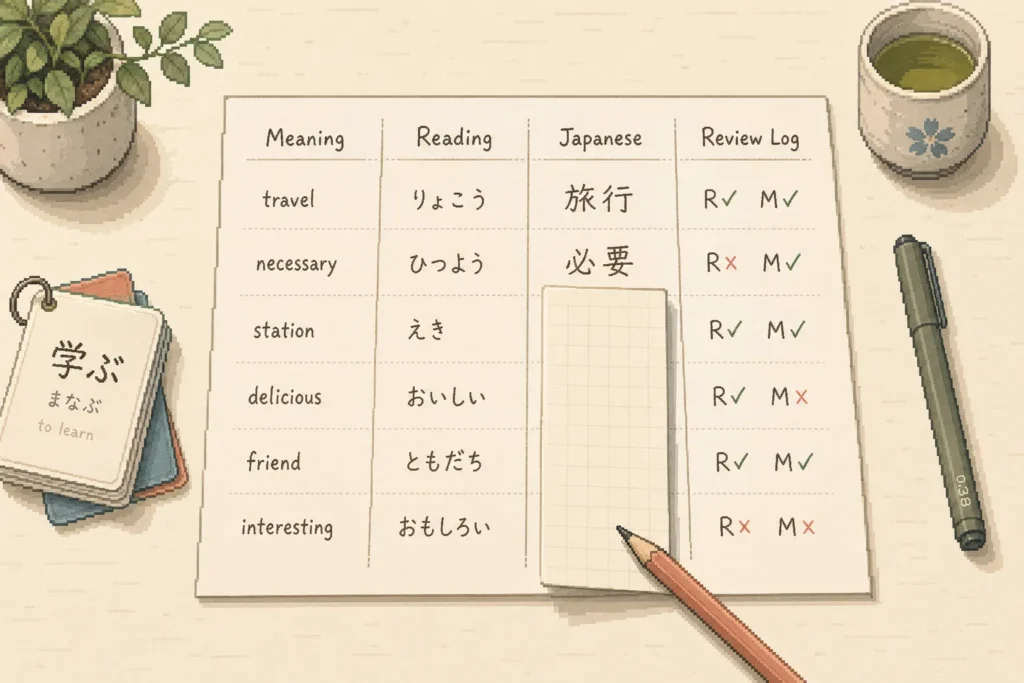
So I fold an A4 sheet into four vertical columns:
| Meaning | Reading | Japanese | Review Log |
| travel | りょこう | 旅行 | R✓ M✓ |
| necessary | ひつよう | 必要 | R× M✓ |
| feeling | きもち | 気持ち | M× |
I use simple review codes:
R = Reading
M = Meaning
S = Spelling / written form
L = Listening recognition
Then I cover different columns and test the word from different directions.
Test 1 — Japanese → Reading
必要 → ひつよう
Test 2 — Japanese → Meaning
気持ち → feeling
Test 3 — Reading or Audio → Meaning
りょこう → travel
Test 4 — Meaning → Japanese
necessary → ひつよう / 必要
I use the last direction selectively for words I actually want to say or write.
A normal vocabulary list tells me what the word means. My A4 sheet tells me what I can actually retrieve.
The point is not to pass four tests once and declare the word memorized. The sheet helps me see which connection currently works and which one needs another retrieval later.
The One Idea Behind the Whole System
A Japanese word can be strong in one direction and weak in another.
I may recognize a word instantly on the page but miss it in a podcast. I may understand the sound but be unable to spell it in kana. I may know the meaning but still be unable to produce the word when I speak.
So I think of vocabulary like this:
Written Form ↔ Sound / Reading ↔ Meaning → Use
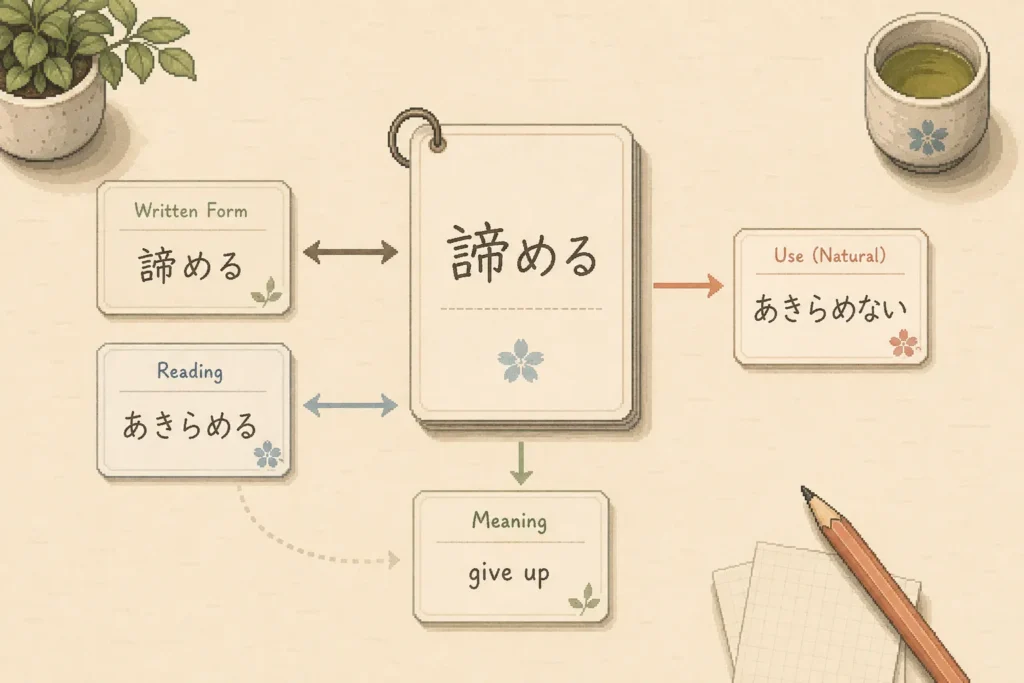
Once I started reviewing the weak connection instead of restarting the whole word, vocabulary practice became much clearer.
Step 1. Attach the Sound When I First Meet the Word
When I first learn 悔しい(くやしい), I do not want to store only:
悔しい → frustrated
I attach the spoken form at the same time:
悔しい → くやしい
Then I connect that sound to one useful meaning: the frustrated, bitter feeling I might have after losing or falling short.
I am not following a strict rule that sound must always come before meaning or writing. I simply make sure the spoken form is present from the first encounter so the written word does not become the only cue I can use.
What I Do
I look at the word, check or hear the reading, and say it once.
悔しい
くやしい
frustrated / bitterly disappointed
Then I make one quick retrieval attempt before moving on.
Move on when: I have connected the written form, sound, and one useful meaning. I do not need to know every nuance yet.
Step 2. Keep the First Pass Brief
Some words invite me to over-study them.
Take そろそろ. Depending on context, I might translate it as soon, about time, or before long. I do not try to memorize every possible English gloss the first time I meet it.
What I Used to Do
| First Encounter | Result |
| Look up every meaning | Too much information |
| Copy the word several times | Feels productive, but the answer stays visible |
| Save several example sentences | More notes than recall |
| Stay until the word feels “done” | Slow progress |
What I Do Now
I keep one practical meaning:
そろそろ — about time / soon
Then I make one retrieval attempt and move on.
Later, when I meet そろそろ帰ろう or そろそろ始めます, real context can refine the meaning.
My first encounter is for building the initial connection, not finishing the word.
Move on when: I recognize the word, know one useful meaning or function, and have made one retrieval attempt.
Step 3. Recall Before I Look at the Answer
This is the simplest change in the whole routine.
Rereading
約束 — やくそく — promise
約束 — やくそく — promise
約束 — やくそく — promise
The word feels familiar because the answer is always there.
Retrieval
I look only at:
約束
Then I ask:
How do I read this?
I try:
やくそく
Then:
What does it mean?
I try:
promise
Only after making a genuine attempt do I check the answer.
The pattern is:
Cue → Recall → Check
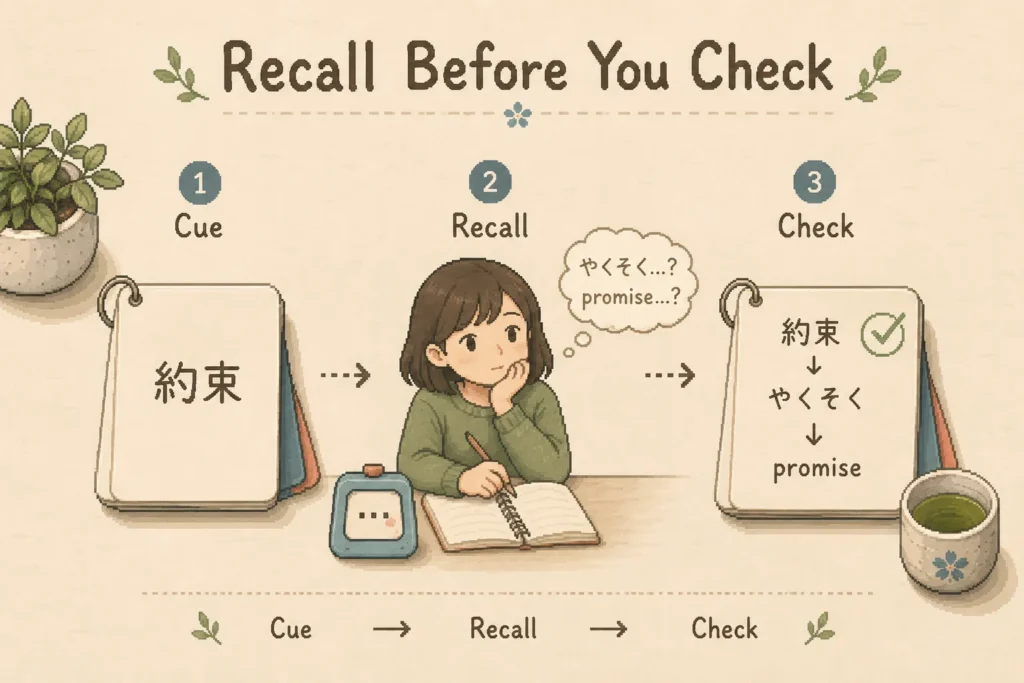
If nothing comes to mind, I do not sit there struggling for a long time. I check the answer, correct myself, and bring the word back later.
Seeing the answer again is not the same as retrieving it.
Move on when: I have made a real recall attempt before looking at the answer.
Step 4. Bring the Word Back Later
If I learn 久しぶり(ひさしぶり) on Monday and look at it several times inside the same session, that is not the same as trying to retrieve it later.
Same-Session Repetition
Monday 7:00 — 久しぶり
Monday 7:02 — 久しぶり
Monday 7:05 — 久しぶり
Spaced Review
Monday — learn it
Tuesday — retrieve it
Later in the week — retrieve it again
The second version tells me whether the word can come back after it has left my immediate attention.
I may use small batches because they make the review easier to manage, but I do not treat a specific batch size as a memory rule. The important part is that the word returns across separate review moments instead of being repeated only inside one sitting.
I also do not wait until every word in a lesson feels perfect before moving forward. Difficult words stay in the review cycle while I continue learning new material.
What I do next: I schedule the next review and keep moving. I do not wait for the word to feel finished in the same session.
Step 5. Diagnose Exactly What I Forgot
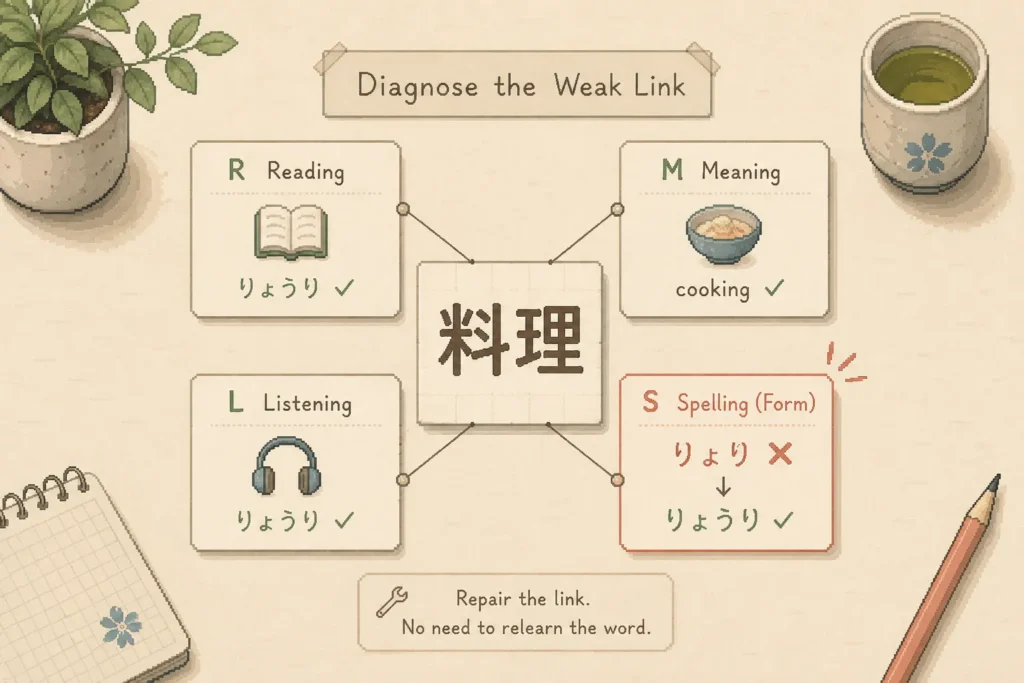
This is the step that changed my vocabulary review the most.
I no longer mark every mistake simply as:
Forgot
Different failures need different fixes.
| What happens | Example | What actually failed | What I practice next |
| I recognize the word on the page but miss it in speech | 大丈夫(だいじょうぶ) | Listening | Audio → meaning |
| I know the sound and meaning but type it incorrectly | 料理(りょうり) → りょり | Spelling / form | Sound → kana |
| I can read the word but the meaning does not come back | せっかく | Meaning | Japanese → meaning |
| I know the meaning but cannot retrieve the reading | 経験(けいけん) | Reading | Written form → sound |
This is much more useful than saying, “I forgot the word.”
If I understand 料理 but repeatedly miss the long vowel in りょうり, another Japanese → English review is not targeting the problem. I need to practice the exact connection that failed.
My repair rule is simple:
R wrong → Written form → Sound
M wrong → Japanese → Meaning
L weak → Audio → Meaning
S wrong → Sound / Meaning → Written form
A word is not a single memory. I can be strong on one link and weak on another.
Move on when: I know which connection failed and I have made at least one targeted attempt in that direction.
Step 6. Use the A4 Review Log to Repair the Weak Link
The Quick Start showed how I test a word in several directions. Step 5 tells me why I missed it. Now I use the Review Log to decide what comes back next.
For example:
| Meaning | Reading | Japanese | Review Log |
| to be late | おくれる | 遅れる | R× M✓ |
| explanation | せつめい | 説明 | R✓ M✓ |
| careful / polite | ていねい | 丁寧 | S× |
I do not give all three words the same review.
If I Mark R×
For 遅れる, the meaning is already fine. The reading is the weak link.
So my next cue is:
遅れる → おくれる
I say the reading, check it, and bring that direction back later.
If I Mark S×
For 丁寧, another meaning review would waste time if the actual problem is written production.
So I might hear or recall:
ていねい
and then type or write:
丁寧 / ていねい
If Everything Is Easy
If 説明(せつめい) is easy in the directions I care about, I stop spending equal review time on it.
The sheet is most useful when it helps me allocate attention, not when it turns every word into the same four-part exercise.
For kana-only words, I adapt the test. If reading and written form are effectively the same cue, I can use audio → meaning or audio → kana spelling instead.
That is why I think of the A4 page as a vocabulary diagnostic sheet, not a copying sheet and not a “four passes = memorized” rule.
What I do next: I carry only the failed links into the next review cycle.
Step 7. Meet the Word Again in Real Japanese — and Reuse It
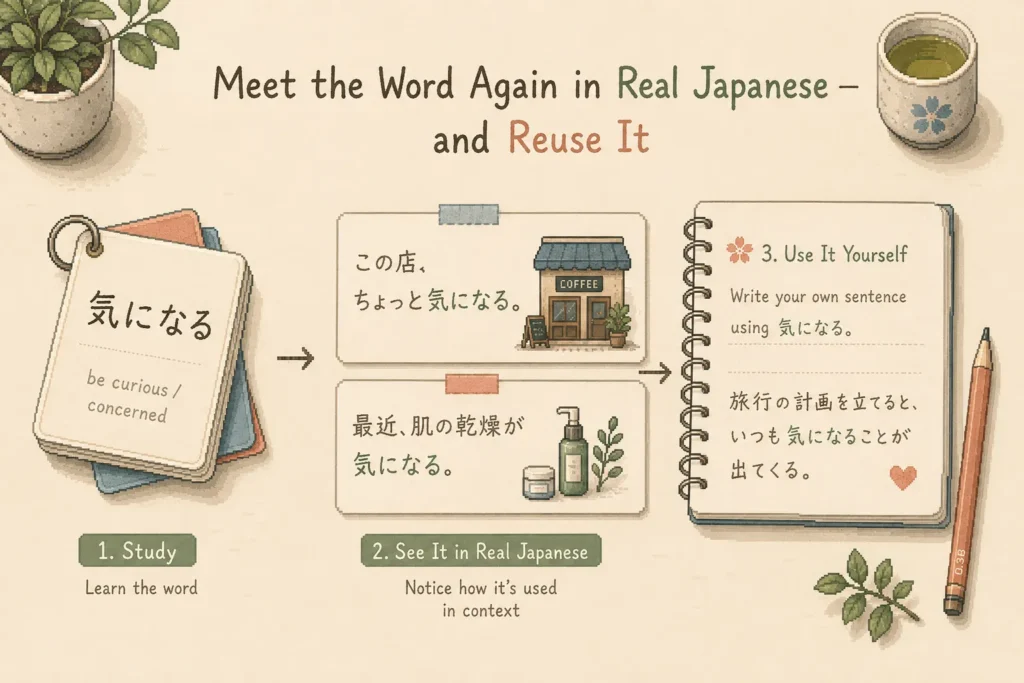
A vocabulary sheet gives me controlled practice. Real Japanese shows me whether the word survives outside that controlled setting.
Take 気になる.
A vocabulary card might say:
気になる = to be curious about / to be concerned about
Useful, but incomplete.
Then I meet:
この店、ちょっと気になる。
I’m kind of curious about this place.
Later:
最近、肌の乾燥が気になる。
Lately, the dryness of my skin has been bothering me.
Now I am not only remembering a translation pair. I am learning where the expression actually works.
Flashcard Japanese vs Real Japanese
| On the Card | In Real Japanese |
| 気になる = be curious / concerned | この店、ちょっと気になる。 |
| One translation | Several natural uses |
| Isolated word | Situation + tone + pattern |
When a studied word appears in a drama, podcast, video, article, or book, I first see whether I recognize it before checking the subtitle or translation.
For listening-heavy practice, I like using Japanese podcasts that match my level because I can hear the same vocabulary inside longer, natural speech instead of only as isolated audio clips.
For shorter reading practice, Todaii can also work well for this stage. The rule stays the same: I try to recognize the word first, then use the reading support or translation only when I need it.
If it is a word I want to use actively, I make one short personal example.
The Tool I Use to Meet Words Again in Real Japanese
One problem I have with vocabulary lists is that a word can become easy inside the list and still disappear when I meet Japanese somewhere else.
This is where I use LingQ. I can read and listen to Japanese with the text beside the audio, save words I am still learning, and keep meeting them inside real content instead of only inside a vocabulary deck.
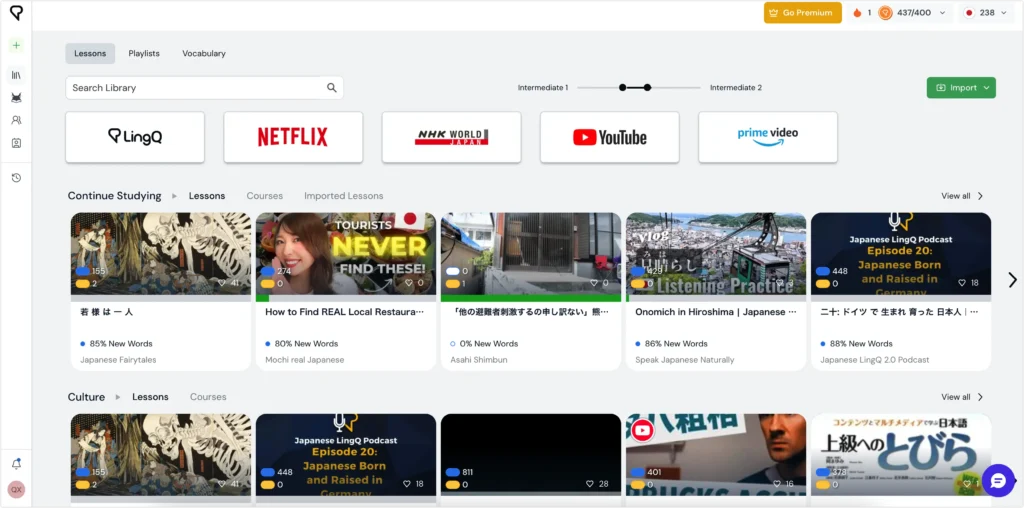
I do not use LingQ to replace retrieval practice. I use it for the next stage of the process:
Can I still recognize this word outside my vocabulary list?
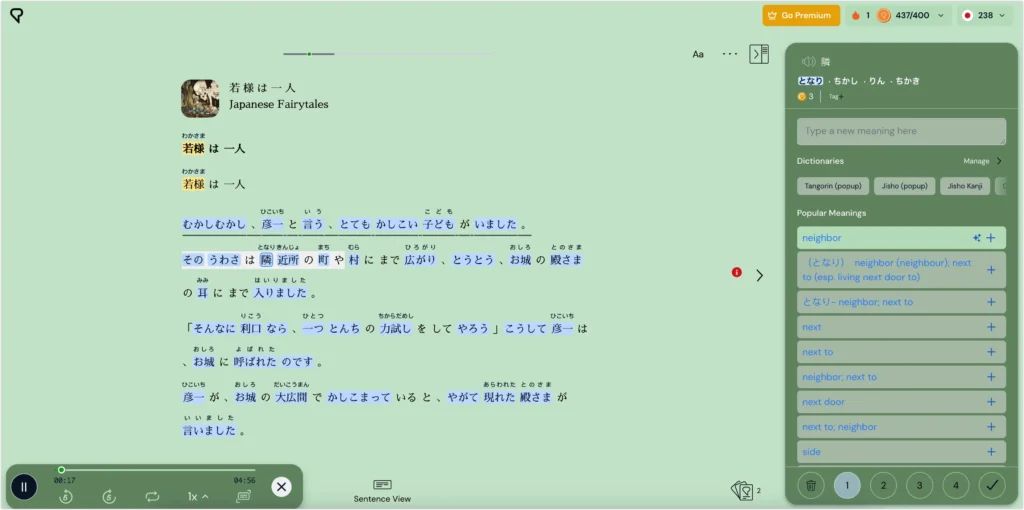
The tool gives me the context. I still try to recognize the word before checking the meaning.
How I Put the 7 Steps Into Practice
A 15-Minute Japanese Vocabulary Session
This is one practical way I organize a short review when I want something structured.
| Time | Activity |
| 0:00–3:00 | First pass: connect form, sound, and one useful meaning |
| 3:00–7:00 | Recall: hide answers and retrieve before checking |
| 7:00–11:00 | A4 sheet: test different directions and mark R / M / S / L |
| 11:00–13:00 | Repair: focus on the links that failed |
| 13:00–15:00 | Real Japanese: read or listen and notice studied vocabulary |
I treat this as a sample routine, not a fixed rule. The point is to give retrieval and diagnosis enough space instead of spending the entire session adding new words.
A Simple 7-Day Review Routine
For a longer review cycle, I use a simple weekly structure.
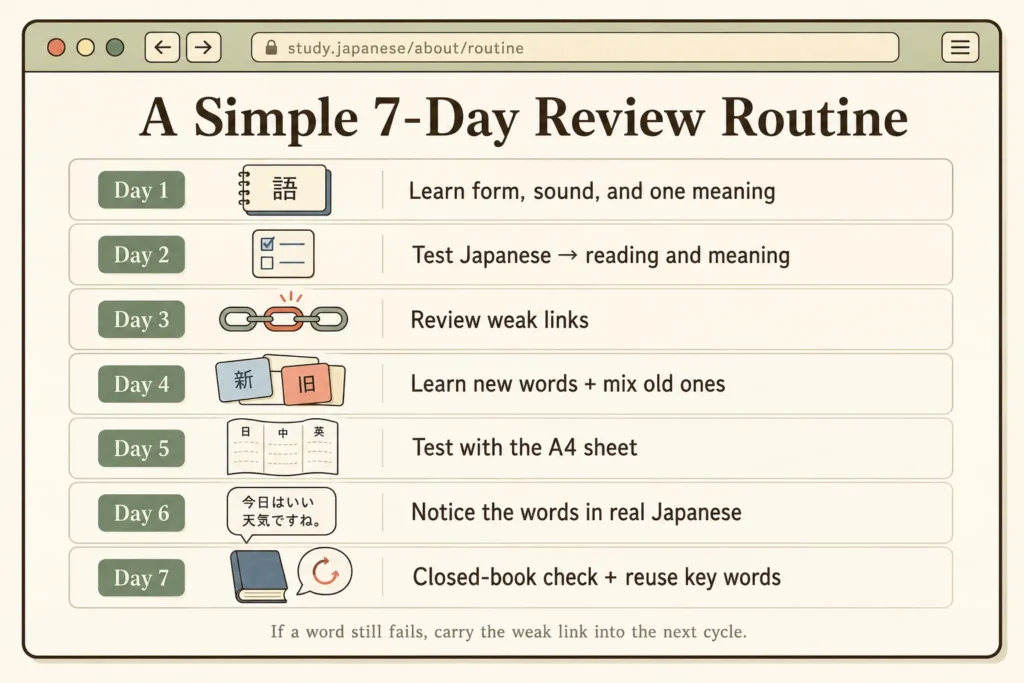
This is a starting routine, not a universal memory schedule. If a word still fails, I carry the weak connection into the next cycle instead of treating the whole word as lost.
Troubleshooting: If Japanese Vocabulary Still Does Not Stick
I Know the Word on Anki but Miss It in Anime
I check what the card is actually training.
If my card always gives me written Japanese and asks for English, I may have trained written form → meaning much more than sound → meaning.
I add an audio-based test instead of simply doing more of the same card. If I keep missing words I already know when they appear at natural speed, I also use shadowing practice to work on the listening side separately.
I Know Hiragana but Kana Words Still Blur Together
I stop treating this as a hiragana-chart problem.
With a word such as なんとなく, I practice recognizing the whole sound and written sequence as one word. Audio → meaning and whole-word recognition are more useful here than drilling individual kana again.
I Know the Sound but Keep Writing It Wrong
I isolate the written-form problem.
If りゅうがく sounds familiar but I keep mistyping the kana, I practice:
sound → りゅうがく / 留学
instead of reviewing the English meaning again.
My Reviews Take Too Long
I reduce how many new words I add.
A smaller new-word intake is more useful to me than rushing through a growing review pile without making genuine recall attempts.
I Keep Forgetting the Same Word
I look at the error pattern.
If the meaning is always fine but the reading fails every time, I stop restarting the entire card. I target the reading connection.
What I No Longer Treat as “Knowing a Word”
I still use notes, writing, flashcards, and dictionaries. I just do not treat seeing the answer, copying it, or recognizing one side of a card as proof that every connection is strong.
If I can retrieve the meaning but not the sound, that is useful information. If I can hear the word but not spell it, that is useful information too.
The goal is not to make every activity harder. It is to make the next review match the part that actually failed.
What About Anki?
I separate two questions:
When should this word come back?
and:
What should I retrieve when it comes back?
Anki can help schedule the first question. The card design determines the second.
If every card asks only Japanese → English, that is the connection I practice most often. For a troublesome word, I may need reading retrieval, audio recognition, spelling, or selective production instead.
So I think of SRS as part of the review system, not the whole vocabulary-learning system.
Frequently Asked Questions
What is the best way to learn Japanese vocabulary?
I combine retrieval, spaced review, and real Japanese exposure. I connect the sound, written form, and one useful meaning, try to recall before checking, then diagnose whether the weak point is reading, meaning, listening, or written form.
How many Japanese words should I learn per day?
I do not use one universal number. I choose an amount that still leaves enough time to retrieve older vocabulary properly. If new words make the review pile unmanageable, I reduce the new-word intake.
Why can I recognize a Japanese word but not understand it when I hear it?
Reading and listening use different cues. If most of my review is visual, the written-form connection may become much stronger than the sound connection. I add audio → meaning practice to test that gap.
Why are hiragana words hard to remember?
Knowing individual hiragana does not automatically make every whole word feel familiar. Some kana-heavy words still need repeated whole-word recognition and listening practice before they become fast and automatic.
Should I learn on’yomi and kun’yomi separately?
I prefer learning readings inside real vocabulary first. As I learn more words, recurring kanji-reading patterns become useful clues, but I do not treat them as rules that predict every word.
Should I write Japanese vocabulary by hand?
Writing can help when the written form is the part I need to strengthen. I just do not confuse copying with retrieval. If I want to test memory, I hide the answer first and try to produce the form before checking it.
Should I learn Japanese vocabulary before kanji?
I do not treat vocabulary and kanji as completely separate stages. I learn useful words with the readings and written forms that are appropriate for my level, rather than waiting until I have memorized every possible kanji reading.
Can I learn Japanese vocabulary from anime?
Anime can give me repeated encounters with spoken Japanese and useful context. I still review deliberately when I want to retain a word, then use anime or other real content to test whether I can recognize that word outside a study list.
Final Thoughts
I used to think vocabulary was binary: either I knew a Japanese word or I had forgotten it.
Now I look at the connection that failed.
If I understand a word but cannot retrieve the reading, I practice the reading. If I know the sound but cannot write the form, I practice the form. If the word works perfectly on a flashcard but disappears in a podcast, I add listening recognition.
Instead of restarting the whole word, I repair the weak connection.
The goal is not to memorize a Japanese word perfectly the first time I see it. The goal is to strengthen the right connection each time the word comes back.