I used shadowing for language learning for weeks and thought I was making great progress. I could keep up with a podcast, match the rhythm, and almost sound like the speaker while the clip was playing. Then I turned it off — and suddenly I could not say the same things on my own.
That was the problem I kept running into. I was getting better at copying the speaker, but not necessarily better at speaking by myself.
Shadowing is genuinely useful for pronunciation, rhythm, and listening. But imitation and independent speaking are not quite the same skill. When you shadow, the speaker is giving you the words and rhythm in real time. When you speak on your own, you have to find the words yourself.
In this guide, I will show you the shadowing routine I use to bridge that gap, so what you practise with audio becomes something you can actually use in conversation.
Quick Start: Try This With One 45-Second Clip
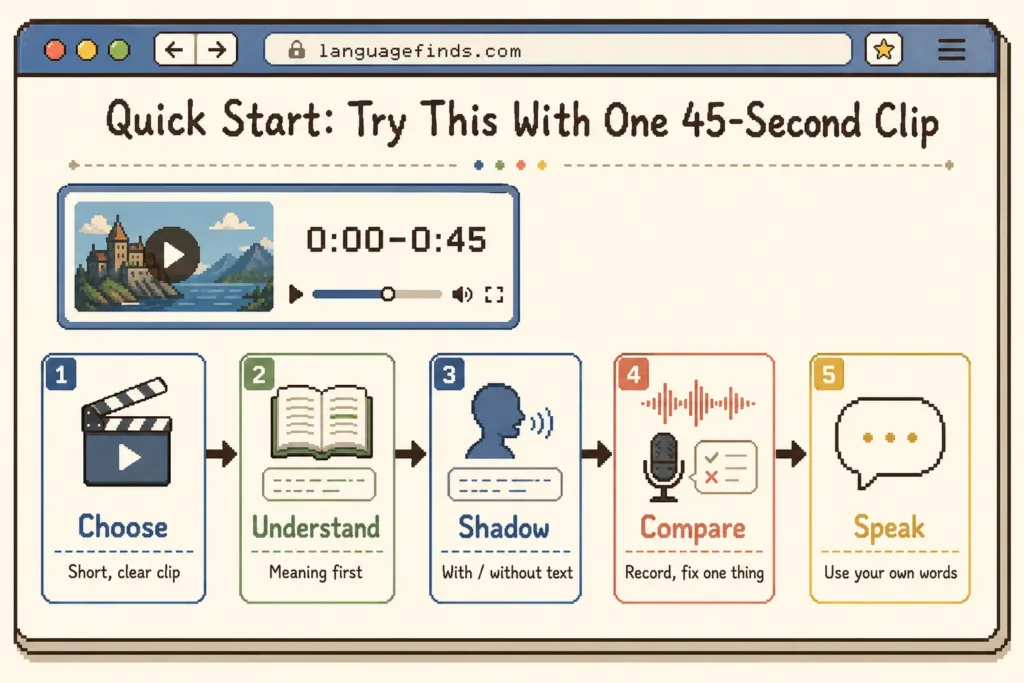
You do not need to read the whole guide first. Here is what to do right now with any short clip.
1. Listen once. No transcript. Catch the general meaning.
2. Check the transcript. Look up only what you missed.
3. Shadow two to three times with the transcript. Notice rhythm, stress, and how words connect.
4. Hide the transcript and shadow two to three times. Do not chase perfect synchronisation.
5. Record yourself once. Find the one most noticeable gap between your voice and the original.
6. Turn everything off and speak for 30 seconds. Use one or two expressions from the clip for something you would actually say yourself.
The sections below explain why each step is built this way — and what to do when any of them feels stuck.
Key Takeaways
- Shadowing works best with short, comprehensible audio from a speaker you actually want to sound like.
- Do not begin by copying sounds you do not understand. Comprehension comes before imitation.
- Record yourself and compare — do not rely on how you sound in your own head.
- Always finish with independent speaking so the language does not stay permanently tied to the original audio.
What Is Shadowing in Language Learning?
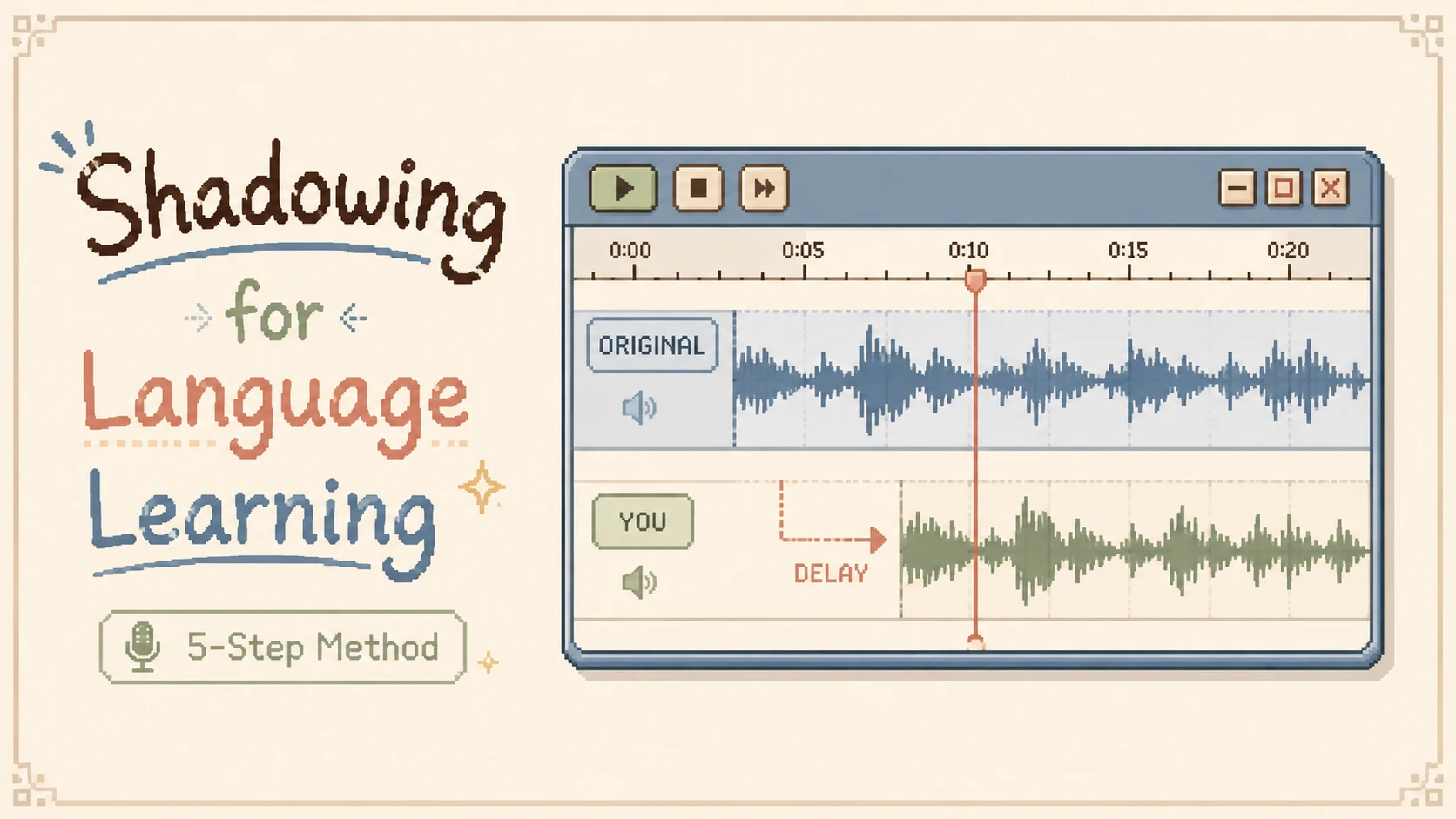
Shadowing means repeating what you hear almost immediately after hearing it — not waiting for a full sentence to finish, but following the speaker with a slight delay of half a second to one second.
It is worth separating three techniques that often get confused:
| Technique | How it works | Best for |
|---|---|---|
| Listen and repeat | Hear a full sentence, wait for it to end, then repeat | Memorising phrases at your own pace |
| Shadowing | Speak almost simultaneously with a 0.5–1 second delay | Rhythm, intonation, and real-time response |
| Delayed repetition | Hear a longer passage, pause, then reproduce what you remember | Memory and recall practice |
All three are useful. Shadowing specifically trains your ear and mouth to respond quickly to real-time speech. It is particularly good at building pronunciation habits and listening speed.
What Shadowing Is Actually Good For
When done consistently with appropriate material, shadowing can improve:
- Pronunciation — individual sounds and how they connect in real speech
- Rhythm and stress — where sentences naturally rise, fall, and pause
- Intonation — the patterns that carry emotion and meaning
- Connected speech — how words blur and link together at natural speed
- Listening speed — your ability to process audio without falling behind
- Pattern recognition — hearing familiar structures automatically, without translating
These are real improvements. Shadowing is not hype.
But there is one thing it does not automatically teach you: how to build your own sentence. Shadowing develops your ability to reproduce language. Producing language independently is a different skill, and most shadowing routines never address it.
That gap is what this guide is designed to close.
Why Shadowing Sometimes Does Not Improve Your Speaking
Before getting into the method, it is worth understanding what goes wrong — because most people make the same mistakes.
You Are Copying Sounds You Do Not Understand
If you shadow material you cannot understand, you are doing phonetic mimicry, not language learning. You might still get some pronunciation practice, but the language is much harder to retain because there is little meaning to attach it to. Meaning should come before imitation.
The Material Is Too Difficult
Fast audio is not automatically better. If large parts of the clip are unclear, you are mostly chasing sounds. When the input is overwhelming, it becomes much harder to process meaning and produce output at the same time. Difficulty should be a slight stretch, not a sprint.
You Never Listen to Yourself
Most people shadow and trust that they sound good because the experience feels smooth. It often sounds different on playback. Recording yourself and listening back can feel uncomfortable, but it gives you a much more honest reference than judging your pronunciation while you are speaking.
You Stop at Imitation
This is the biggest issue. If every session ends with the audio still playing, you never practise speaking without a model. You train yourself to be dependent on the original speaker. When the audio disappears, so does your ability to produce the language.
The five-step method below addresses all of this.
How to Do Shadowing for Language Learning in 5 Steps
Step 1. Choose a 30–60 Second Clip You Can Mostly Understand
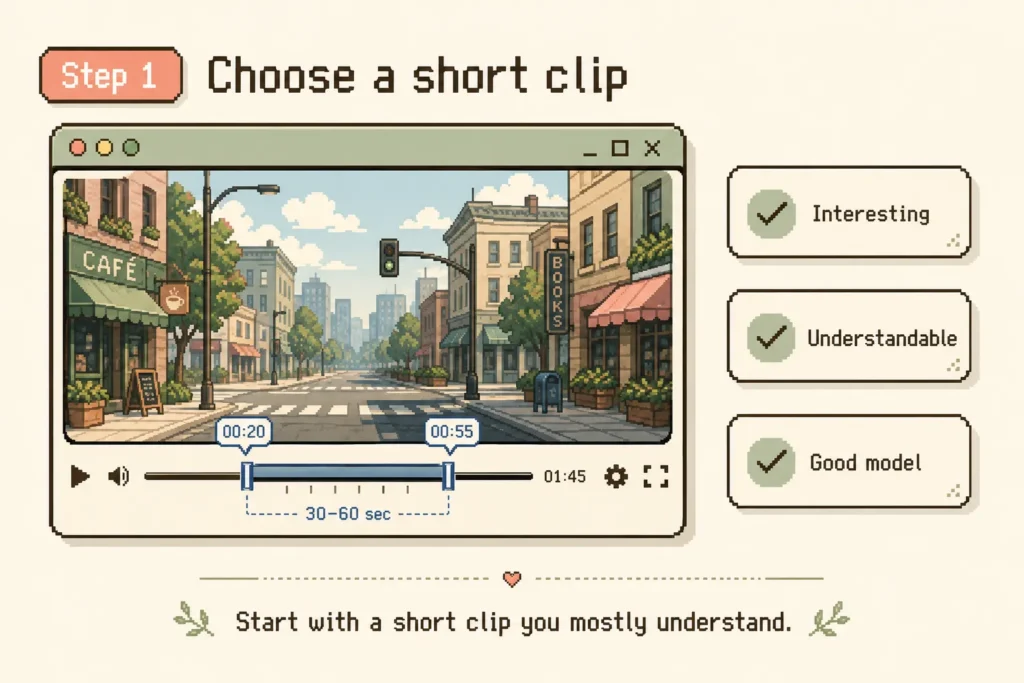
Length matters. Most people pick something too long. A single minute of dense audio contains more than enough material for one productive session.
Good sources include podcasts, YouTube videos, drama dialogue, interviews, and news clips. The format matters less than the content.
Three criteria for choosing material:
Interesting. If you are bored by the content, your attention will drift and retention will drop.
Understandable. You should be able to follow the meaning with a little effort. Unknown words are fine. Unknown everything is not.
Worth sounding like. Not every native speaker is a useful model. Regional accents, very fast informal speech, or heavy use of filler sounds may not be what you want to internalise at this stage. Because you are deliberately imitating the speaker, choose a voice and speaking style you would actually like to approximate.
Step 2. Listen for Meaning Before You Shadow
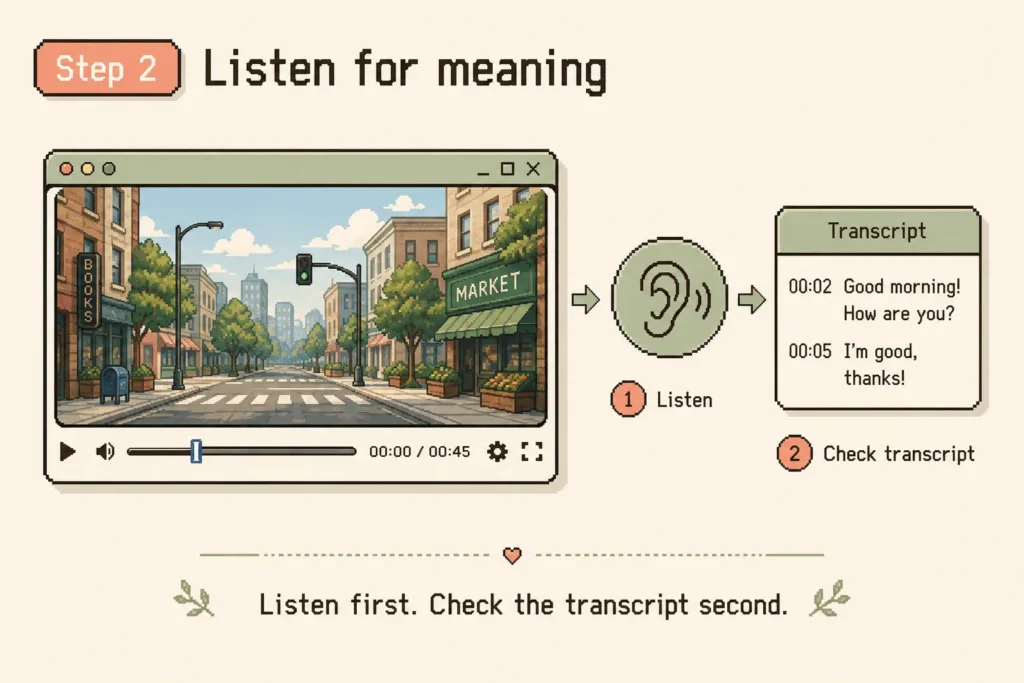
Do not shadow on the first listen.
Play the clip once and focus only on comprehension. Notice:
- What is the speaker saying overall?
- Which sentences did you miss completely?
- Which words did you recognise in context but would not have caught at speed?
If you have a transcript, follow this order: listen first, then read. Looking at the text while listening tends to shift attention to the written form rather than the sound.
This step is not optional. If you skip it, you shadow without meaning — which is exactly the problem described in the previous section.
Move on when: you understand the main idea and can describe the clip in one sentence.
Step 3. Shadow With the Transcript
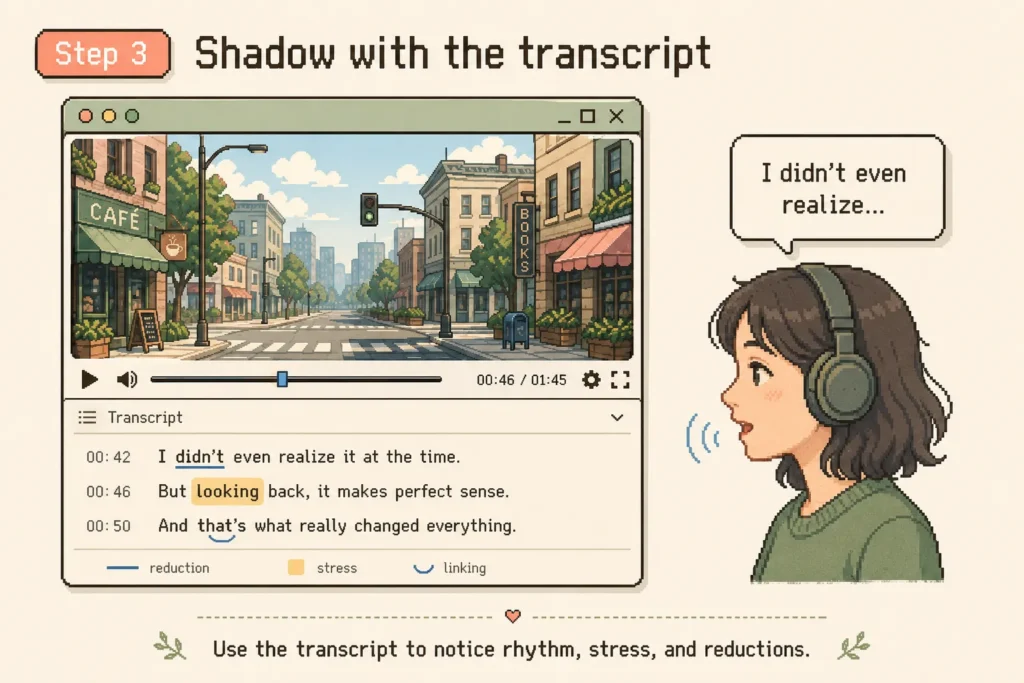
Now shadow, with the transcript in front of you.
Your goal here is not speed. You are listening for:
- Pauses — where does the speaker naturally breathe or break?
- Stress — which words carry the weight of the sentence?
- Rhythm — what is the overall beat and flow?
- Reductions — where do sounds disappear or blend together?
- Sentence endings — how does intonation fall or rise at the end?
As a concrete example, take a sentence like:
“I didn’t even realise how much time had passed.”
Said naturally, it might sound closer to:
“I didn’t eeven realise how much time’d passed.”
The written form and the spoken form are different. Shadowing with the transcript helps you map one onto the other.
Do not worry about matching the speaker perfectly. Focus on noticing the patterns.
Move on when: you can follow most of the sentence without constantly stopping to catch up.
Step 4. Shadow Without the Transcript
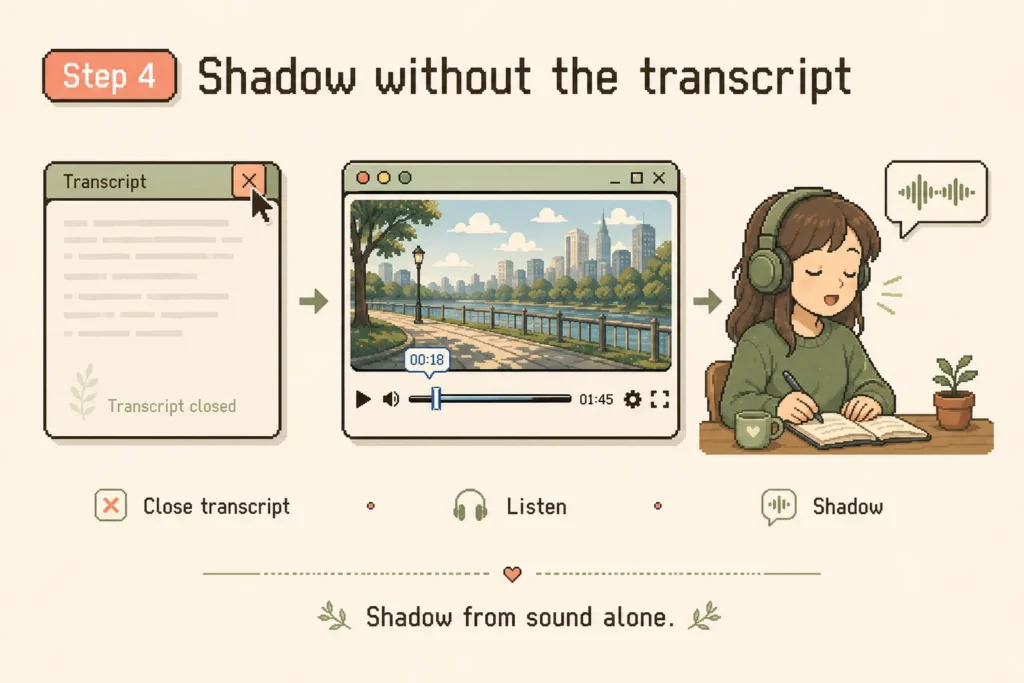
Close the transcript and shadow the same clip again.
Start with a delay of half a second to one second behind the speaker. As you become more comfortable, you can close the gap — but do not make speed the goal.
You do not need perfect synchronisation. Shadowing is not a performance. Falling slightly behind is fine. Losing a word and picking back up is fine. The goal is to train your ear and mouth to work together, not to prove you can keep up with a native speaker.
Repeat the clip two or three times without the transcript. Each time, notice something different — once for rhythm, once for a specific sound, once to see how much you can anticipate before you hear it.
Move on when: you can shadow the clip without needing to glance at the transcript.
Step 5. Record Yourself, Compare, and Fix One Thing
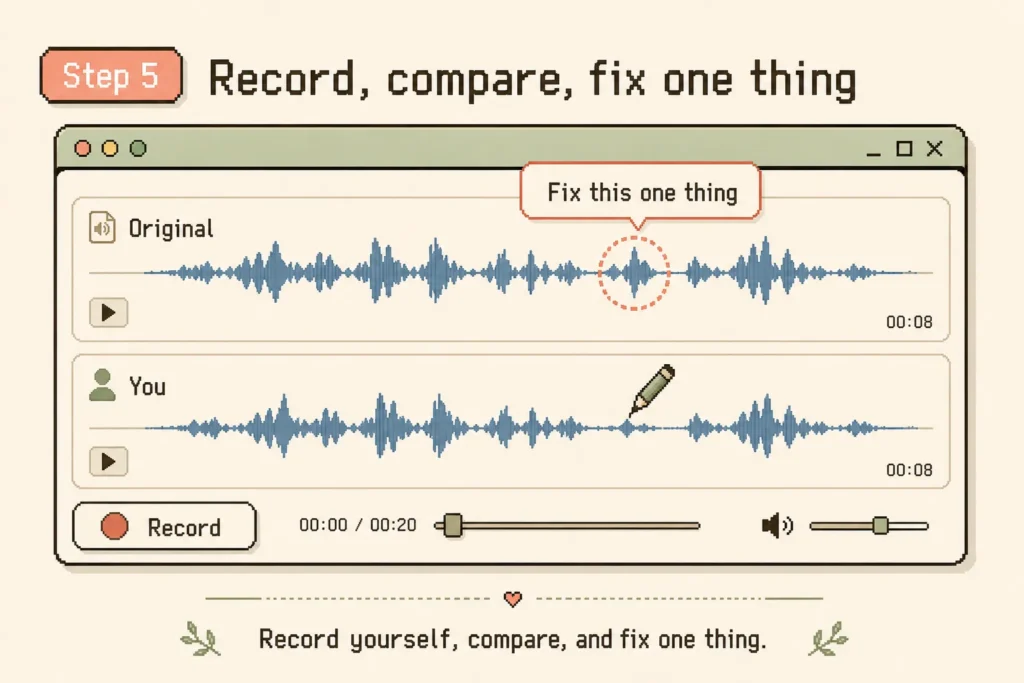
This is the step most people skip, and it is the one that creates actual improvement.
Record yourself shadowing the clip. Then listen to the recording and compare it directly to the original audio.
Do not try to fix everything at once. Each session, pick one specific thing:
- Word stress on a particular phrase
- The ending sound of a sentence
- An intonation pattern
- The reduction of a common word
Repeat that section until the one thing you targeted sounds closer to the original.
This is also where external feedback becomes genuinely useful. When you listen to your own recording, it can be difficult to hear exactly what is different — especially for sounds that do not exist in your first language. Your brain tends to hear what it expects rather than what is actually there.
Getting External Feedback: Speechling
When you genuinely cannot identify what is different between your recording and the original, self-comparison alone has a ceiling. This is where Speechling becomes useful.
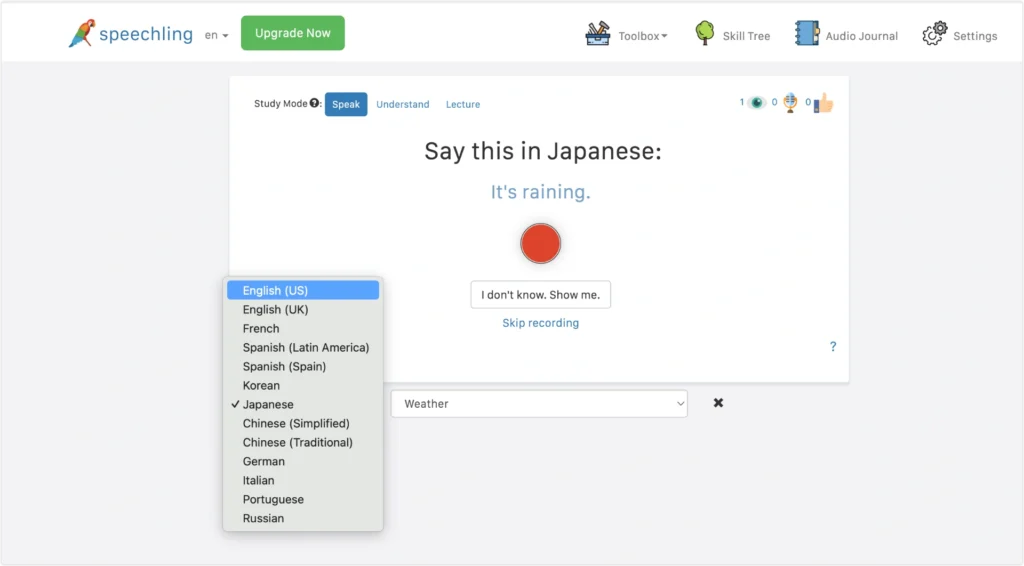
The core loop is simple: Speechling plays a sentence spoken by a native speaker, you record yourself saying the same thing, and the interface shows both waveforms side by side. The visual comparison often reveals rhythm and vowel length issues before your ear can catch them — you can see where your recording is compressed or rushed even if it sounds acceptable to you on playback.
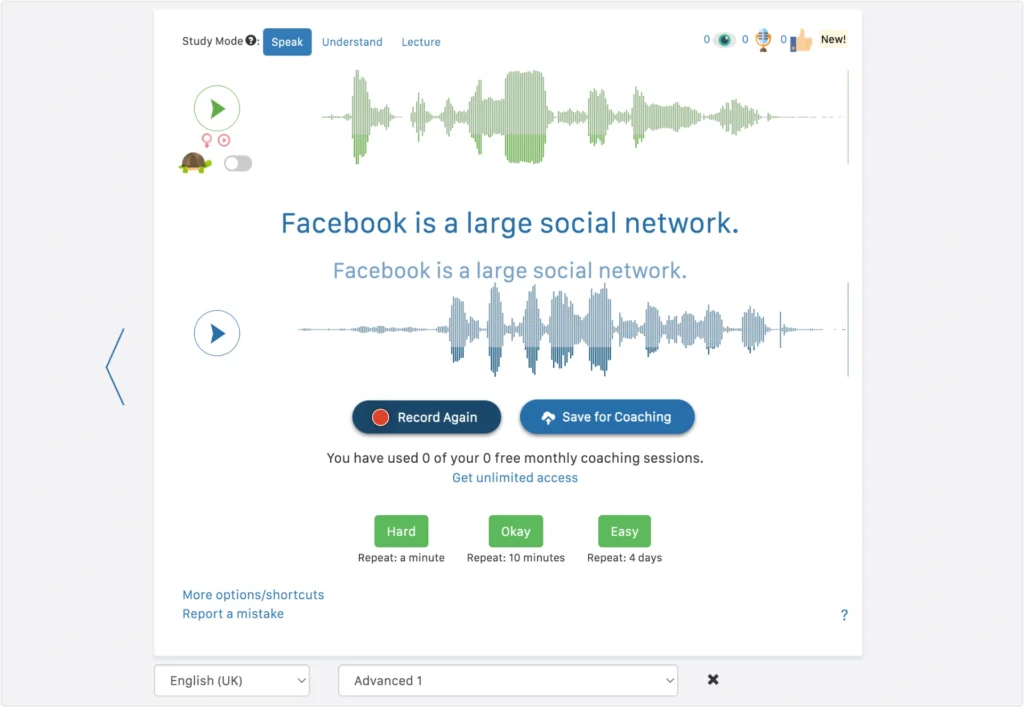
If you want more specific feedback, you can save a recording for coaching. A native speaker reviews it and sends back notes on exactly what is different — not a generic correction, but a response to your specific recording.
A few things that make it practical for this method in particular:
- It supports Japanese and Korean alongside other languages, so it fits directly into the kind of material Language Finds readers are working with.
- Practice is organised by topic (weather, daily conversation, and so on), which means you can use it alongside the same content you are shadowing rather than switching to unrelated material.
- After each recording, you rate it as Hard, Okay, or Easy. The built-in spaced repetition system brings back sentences you struggle with more frequently, so you are not managing a separate review list.
Speechling is not a substitute for the self-comparison step above — forming your own judgment about what is off is itself a skill worth developing. But when you are stuck and cannot name the gap, it gives you a concrete external reference instead of leaving you to guess.
Move on when: you have identified and corrected one noticeable difference between your recording and the original.
A Real Shadowing Example
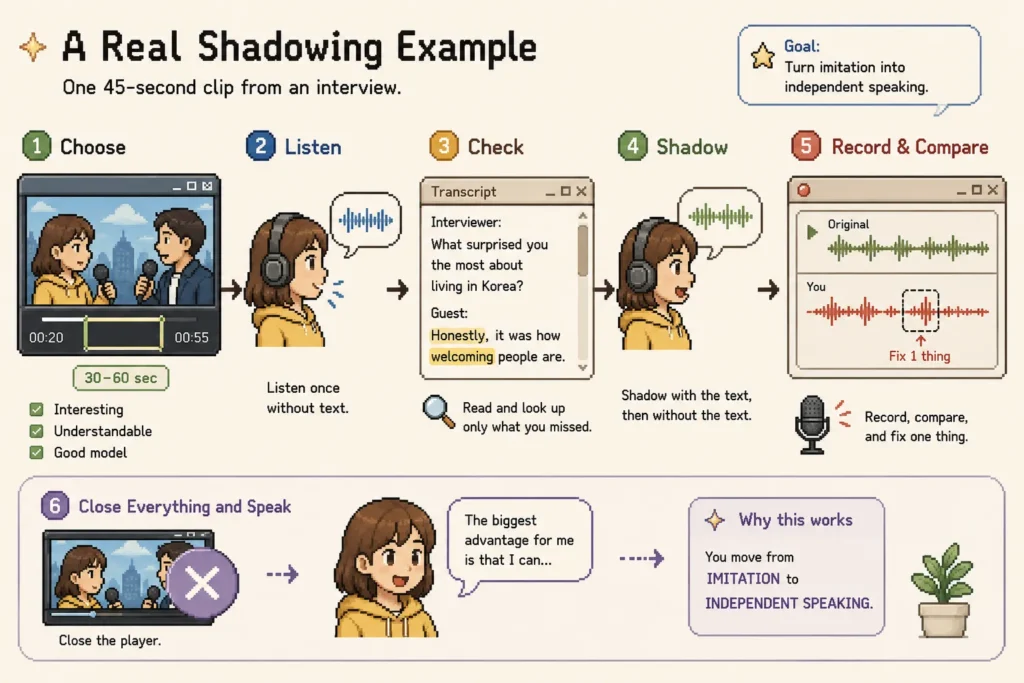
Here is what the method looks like in practice. The clip contains this sentence:
I didn’t really expect it to take this long, but I’m glad I stuck with it.
First listen
Ask yourself: what happened? Did I hear every word? You might catch expect, long, and glad, but miss stuck with it at natural speed.
Check the transcript
Look up what you missed. Notice expressions you recognise in print but did not catch in real time: expect it to, I’m glad I, stick with something.
Shadow with the transcript
Before shadowing, mark the sentence for stress:
I didn’t REALLY expect it / to take this LONG / but I’m GLAD I stuck with it.
Shadow two to three times, following those stress points rather than trying to copy every sound at once.
Shadow without the transcript
Close the text. Shadow the same sentence two or three times. You will probably fall slightly behind on stuck with it — that is fine. Keep the rhythm.
Record
Listen back. You notice that stuck with it comes out word by word instead of as a single connected phrase. That is your one thing to fix today. Repeat only that section until it sounds joined.
Independent output
Close everything. Now say:
I didn’t expect learning Korean to take this long, but I’m glad I stuck with it.
You have taken the original structure, replaced the content with something from your own life, and produced it without any audio playing. That is the transfer this method is designed to create.
The Step Most Shadowing Guides Miss: Speak Without the Audio
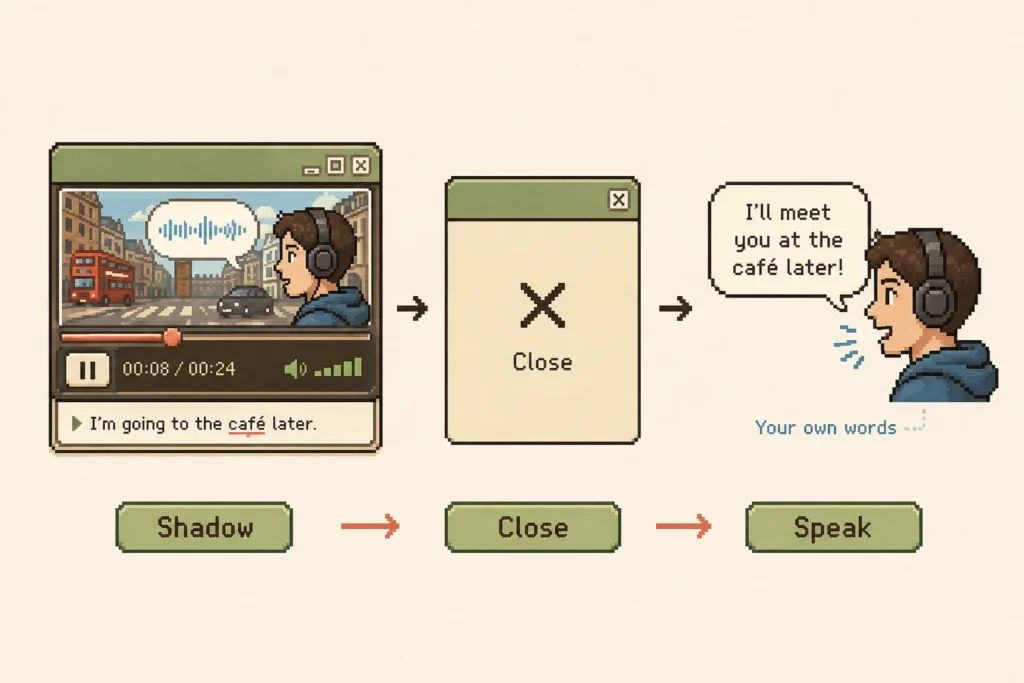
After you have shadowed and compared, do one more thing: close everything and speak on your own.
Do not try to recite the clip. Instead, take the topic or situation the speaker was discussing and say something yourself.
If the clip was someone explaining why they prefer working from home, your task is not to repeat their explanation. It is to answer the same question in your own words:
Do you prefer working from home? Why or why not?
Use whatever vocabulary and phrases from the clip felt natural. Ignore the rest. The point is to move from imitation to independent production — to detach the language from the original audio and attach it to your own thoughts.
The sequence is simple:
Shadow → Close → Recall → Reuse
This is the step that converts shadowing practice into speaking ability. Without it, you are training a skill that only works when the audio is playing.
Finish when: you can say something new using at least one expression from the clip.
A 15-Minute Shadowing Routine
If you want a practical structure you can use immediately:
| Time | Activity |
|---|---|
| 0:00 – 2:00 | First listen (meaning only, no repeating) |
| 2:00 – 5:00 | Check transcript, mark unclear sections |
| 5:00 – 9:00 | Shadow with transcript, then without |
| 9:00 – 12:00 | Record yourself, listen back, fix one thing |
| 12:00 – 15:00 | Close everything, speak freely on the same topic |
A focused 15-minute session is often enough to work through one short clip without turning the exercise into passive repetition.
If Shadowing Feels Too Hard, Do This
| Problem | What to do |
|---|---|
| I cannot keep up with the speaker | Slow the audio slightly, or choose a shorter clip. Keeping up is not the goal — noticing the patterns is. |
| I can read the transcript but cannot hear what I am reading | Replay only the unclear sentence and listen alongside the transcript until the written and spoken forms match. |
| I understand it, but my mouth cannot follow | Switch temporarily to listen-and-repeat for that sentence. Once your mouth can reproduce it without real-time pressure, return to shadowing. |
| I sound different but cannot work out why | Compare one feature at a time — stress first, then vowel sounds, then endings. Speechling is useful here: record a phrase and receive feedback from a native speaker coach on what is different. |
| I can shadow perfectly but still cannot speak independently | Stop shadowing. Close the audio and do the 30-second independent output task. More shadowing is unlikely to solve this on its own — you need to practise speaking without the model. |
How to Choose Good Shadowing Material
Choose Someone You Actually Want to Sound Like
Most people pick material based on convenience rather than intention. Think about what register, accent, and speaking style you are aiming for, and choose a speaker who represents that.
Use Short Clips
A podcast episode is not a shadowing session. A 45-second excerpt from that podcast episode is. Shorter material allows you to go deeper — multiple passes, focused attention, real improvement on specific features.
Stay Near Your Current Level
Material that is slightly challenging is ideal. Material that is mostly incomprehensible is not a sign of ambition — it is a sign that the method will not work. If you cannot follow the meaning, there is much less useful language for you to notice, remember, and reuse.
Prefer Audio With a Transcript
Especially in the early stages. Transcripts let you verify what you heard and catch the gap between how a word is written and how it actually sounds. As your listening improves, you can shadow more material without transcripts. But there is no point in avoiding them early on.
When Should You Stop Repeating a Clip?
You do not need a clip to be perfect before moving on.
Move to new material when:
- You understand the clip fully without the transcript
- Your rhythm and stress roughly match the original
- You have addressed the most noticeable pronunciation gap you identified
- You can reproduce the main ideas without the audio playing
Holding onto a single clip for too long produces diminishing returns. The goal is not to master one short piece of audio. It is to use each clip to build habits that carry across to new material.
Common Shadowing Mistakes
| Mistake | Why it matters |
|---|---|
| Choosing material that is too difficult | If you cannot follow the meaning, you are chasing sounds rather than acquiring language. |
| Shadowing too long a clip | Longer is not better. A short clip worked through carefully produces more than a long one done passively. |
| Chasing synchronisation | Matching the speaker perfectly is not the goal. Noticing and internalising patterns is. |
| Skipping the recording step | It is difficult to assess your pronunciation accurately while you are speaking. You need the playback. |
| Never speaking independently | If every session ends with the audio still on, you are practising imitation, not fluency. |
Frequently Asked Questions
Does shadowing really improve speaking?
It improves specific aspects of speaking — pronunciation, rhythm, intonation, and the ability to produce sounds at natural speed. It does not automatically improve your ability to construct sentences or express your own ideas. For that, you need the independent output step described above.
How long should I shadow each day?
Fifteen to twenty focused minutes is plenty for a daily session. Consistency matters more than making each session long, and a short routine is easier to repeat regularly.
Is shadowing good for beginners?
It depends on the material. Complete beginners who have no listening foundation yet will struggle, because shadowing requires you to process meaning and produce sound simultaneously. If you are at a very early stage, spend time building listening comprehension first. Once you can follow simple audio, shadowing becomes useful.
Should I shadow with or without subtitles?
For the first pass, use the transcript to check comprehension. Then shadow without it. Reading while shadowing splits your attention and tends to train your eyes more than your ears.
How many times should I repeat the same audio?
For a short clip, a few focused passes are usually enough. Stop when you are no longer noticing useful differences. If you shadow the same clip across multiple days, you will notice your attention to detail improving — you will catch things on day three that you missed on day one.
Can I use movies, dramas, podcasts, or YouTube for shadowing?
All of these work. Drama dialogue is particularly useful because it tends to be clear, emotionally varied, and contextually rich. Podcasts work well if the speaker has a natural but not excessively fast delivery. Whatever you choose, make sure the audio quality is clean enough to hear connected speech clearly.
Final Thoughts
Shadowing is best treated as a bridge.
It helps you move from hearing a language to reproducing its rhythm, stress, and pronunciation. But the bridge only goes somewhere if you take the last step: close the audio, close the transcript, and try to say something yourself.
The speakers you shadow have spent years building the intuitions you are trying to develop. You are not going to absorb those intuitions by repeating after them with the audio still playing. At some point, you have to let go of the model and trust what you have built.
Listen. Notice. Imitate. Compare. Reuse.
That sequence — done consistently, with short material at the right level — is what actually moves the language from something you can copy into something you can use.
Enjoyed this guide? You might also like: