If Language Transfer Spanish feels too fast, pause before the recorded student's answer and give yourself time to think. Work with a short section, identify one point you cannot follow, and return to it before moving on. You do not need to keep pace with the person in the recording for the activity to be useful.
Start by separating three difficulties: understanding the English explanation, building the Spanish answer, and recognizing Spanish when you hear it. Each needs a slightly different response.
The routine below is an editorial suggestion based on official course guidance and a linked learner discussion, checked on October 22, 2026. We have not tested it as a learning intervention or completed a lesson-by-lesson course assessment.
Is Language Transfer suitable for beginners?
The official Language Transfer FAQ says its courses are designed for beginners, while also explaining that they become advanced quickly. It describes the order and explanations as different from a conventional course.
That matters if you assume “beginner” means every activity will remain easy. You may understand an explanation when you hear it and still need more time to construct an answer independently.
“Complete Spanish” is the course name, not a guarantee of complete command of Spanish. The FAQ describes the complete courses as exploring the language's structural landscape and developing a base for continued learning. It also encourages learners to use the language through reading, listening, and interaction after the course.
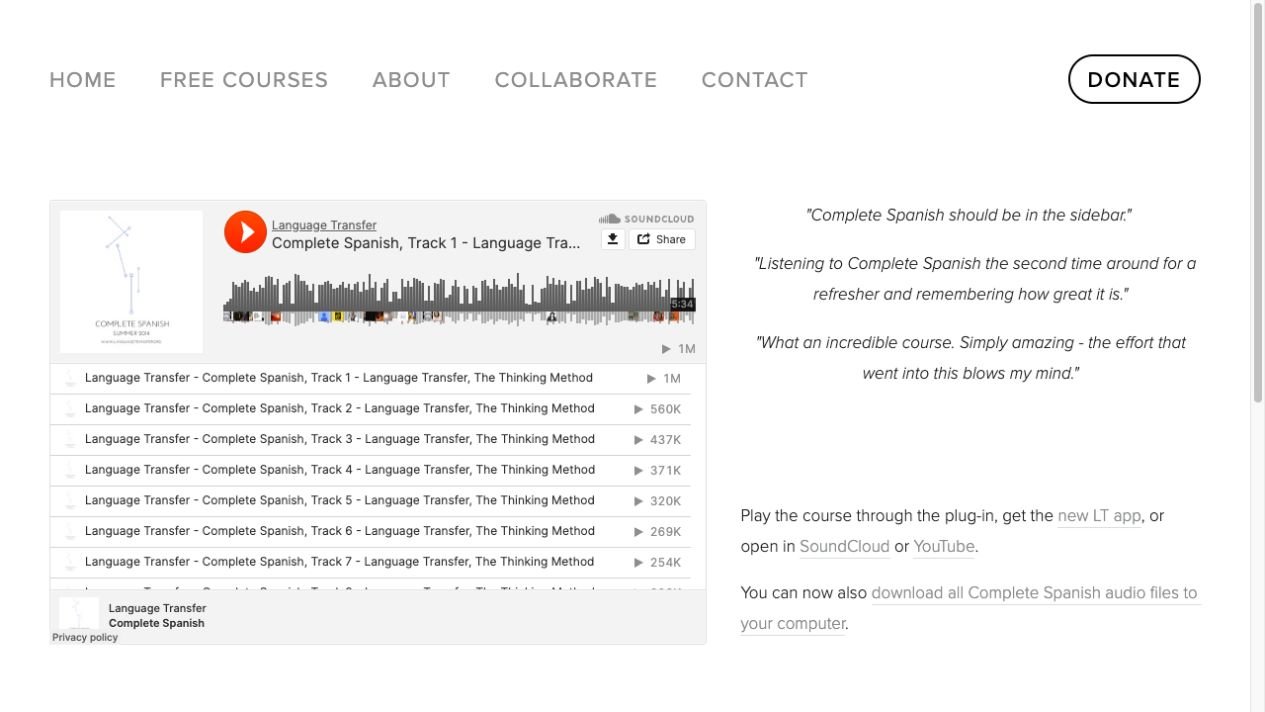
You can find the official Complete Spanish course page, with links to the app, SoundCloud, YouTube, and audio downloads. The project describes its materials as free to access, without advertisements or required sign-ups. Donations support the project.
One learner's experience of getting stuck
In a May 2025 Reddit post, a complete beginner described enjoying the first lessons, then struggling to keep up. By lesson 14, even repeated listening left them feeling lost.
That is one person's experience, not a finding that lesson 14 is universally too difficult. It does capture a recognizable problem: replaying a whole recording does not always reveal which step in an explanation you stopped following.
Replies offered different approaches, including a slower audio course and more Spanish exposure alongside the explanations. They also disagreed about learning methods. You do not need to settle that entire debate to make your next session more manageable.
First identify what you are trying to do when you get stuck.
Find the point where you lose the thread
| What happens | A useful next action |
|---|---|
| You cannot follow the English explanation | Pause and check the explanation, using the transcript if necessary. |
| The explanation makes sense, but you cannot build the answer | Leave more thinking time before hearing the model response. |
| You copy the recorded answer without knowing how it was formed | Go back to the question and work through the missing step. |
| You answer in the lesson but struggle with other Spanish audio | Add short, easier Spanish listening rather than only replaying explanations. |
| Each new section feels harder and harder | Reduce the amount you attempt and revisit the earlier point you need. |
These are practical distinctions, not diagnoses. You may experience more than one in the same session.
Try to make the difficulty specific. “I forgot which form the question needs” gives you something to revisit. “I'm bad at languages” does not tell you what to do next.
Pause before the answer, not only after it
Hearing the answer can make it feel immediately familiar. That is different from reaching it on your own.
When the instructor asks a question, pause before the recorded student answers. Think through your response without watching a transcript. If useful, try saying your answer, then listen to the response in the recording.
If you disagree with the model, return to the relevant explanation. Was the difficulty meaning, a word you could not recall, or how the sentence was put together? Revisit that part rather than starting the entire lesson again automatically.
There is no fixed response time you need to beat. A pause can make space for the thinking the activity asks of you.
Use transcripts for support and revision
A transcript can help you locate a passage or understand an English explanation. It can also make it easy to read an answer before you have tried to construct it.
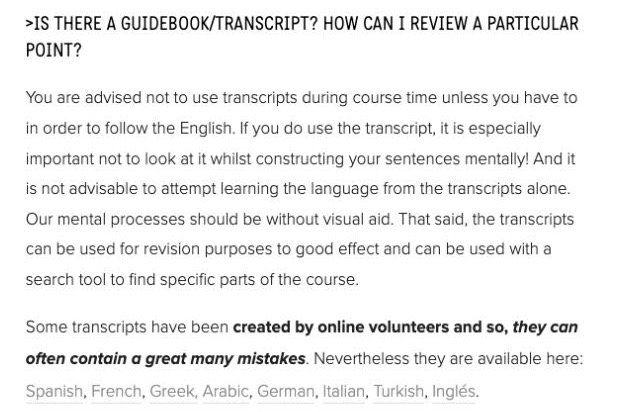
The official FAQ advises against using transcripts during course time unless needed to follow the English. It particularly discourages looking at them while mentally constructing sentences. It does, however, describe using them for revision and finding specific parts of the course.
The FAQ also warns that volunteer-created transcripts can contain mistakes. Treat unfamiliar spelling or a confusing line as something to verify, rather than automatically assuming that the transcript is correct.
If you need a transcript to access the explanation, use it. Then, where possible, put it aside for the part where you try to form an answer yourself.
Try this adjustable 15-minute session
This is an example schedule, not an official Language Transfer timetable. The intervals are there to keep the session small; change them when an explanation needs more time.
| Time | Activity |
|---|---|
| First 2 minutes | Return to one earlier question you remember and try answering without the model. |
| Next 8 minutes | Work through a short section, pausing before answers. You may cover only part of a track. |
| Next 3 minutes | Revisit one point that confused you, then attempt the question again. |
| Last 2 minutes | Stop playback and decide what you will return to next time. |
Do not force a whole track into the session just to finish it. If you spend the available time understanding one useful point, you have still done the work you selected.
You can note a timestamp or question afterward if that helps you find it again. You do not need to transcribe the lesson while trying to follow it.
Add Spanish you can actually follow
A course can make a structure clearer without giving you enough experience recognizing it in different voices and situations. Leave some room for Spanish material outside the explanation.
Choose a short item with a topic and difficulty you can follow. Dreaming Spanish is one video resource to investigate; Easy Spanish offers another route into conversations and interviews. Their formats and difficulty vary, so sample the material rather than assuming every video will suit a beginner.
A modest task is enough: identify the topic, notice a familiar expression, or understand one short exchange. You do not have to extract every unknown word or turn the entire video into flashcards.
If you understand almost nothing, find easier material. Struggling through a long, opaque recording is a different activity from listening to something you can partly understand.
Should you repeat a lesson or move on?
Repeat when you can name a question you want to answer differently. For example, you may want to understand why one response uses a particular structure or try it without hearing the model first.
Move forward cautiously when you can follow the main reasoning, even if your response is slower than the recording. Keep the option to return.
If the same missing step keeps disrupting later material, go back to that point. Replaying a long sequence without identifying the gap can turn review into an endurance exercise.
You do not need a perfect record before continuing, but you should have some idea of what the next section builds on.
When another resource may be a better next step
If the pace and explanation style continue to frustrate you, it is reasonable to try another approach. That is a choice about fit, not a verdict on your ability.
Pimsleur appeared in the Reddit discussion as a slower alternative preferred by some participants. That is a learner recommendation to investigate, not a timing comparison we have independently measured. Check a current sample before buying.
You could also keep Language Transfer for occasional explanations while using a different beginner course as your main sequence. Choose one clear role for it, rather than making yourself complete it simply because other learners praise it.
Questions beginners ask
Can I learn Spanish from Language Transfer alone?
Use it for what the course provides, then make room to hear, read, and use Spanish beyond the recordings. The official FAQ itself points learners toward broader exposure and interaction after the course.
How many lessons should I do per day?
Choose an amount that leaves time to think through the questions. For a difficult section, part of a lesson may be enough. There is no evidence here for a universal daily target.
Should I write everything down?
That is not necessary for the routine above. Follow the official advice about thinking without visual answers during the activity. Use a timestamp or brief reminder afterward if it helps you return to a specific point.
What if I am slower than the recorded student?
Pause. The recording can continue only when you let it. Your next useful step is to understand and attempt the question, not to match someone else's response time.
Sources
- Language Transfer official homepage: access model and project information, checked October 22, 2026.
- Complete Spanish official course page: listening and download routes, checked October 22, 2026.
- Language Transfer FAQ: beginner level, course scope, transcript guidance, and continued learning, checked October 22, 2026.
- Reddit: Beginner feeling overwhelmed by Language Transfer: May 13, 2025, with selected replies.