This post contains affiliate links. If you sign up through my links, I may earn a small commission at no extra cost to you — and it helps keep this blog running. Thanks for your support!
⚡ 3 Things to Know Before You Read
- Lingopie is a streaming platform with its own Japanese content library — plug in and start watching immediately.
- Migaku is a toolkit that layers on top of Netflix and YouTube — more powerful, but requires setup.
- For most learners, Lingopie is the easier, more enjoyable way in — curated shows, zero setup, and built-in tools that make Japanese feel fun from day one.
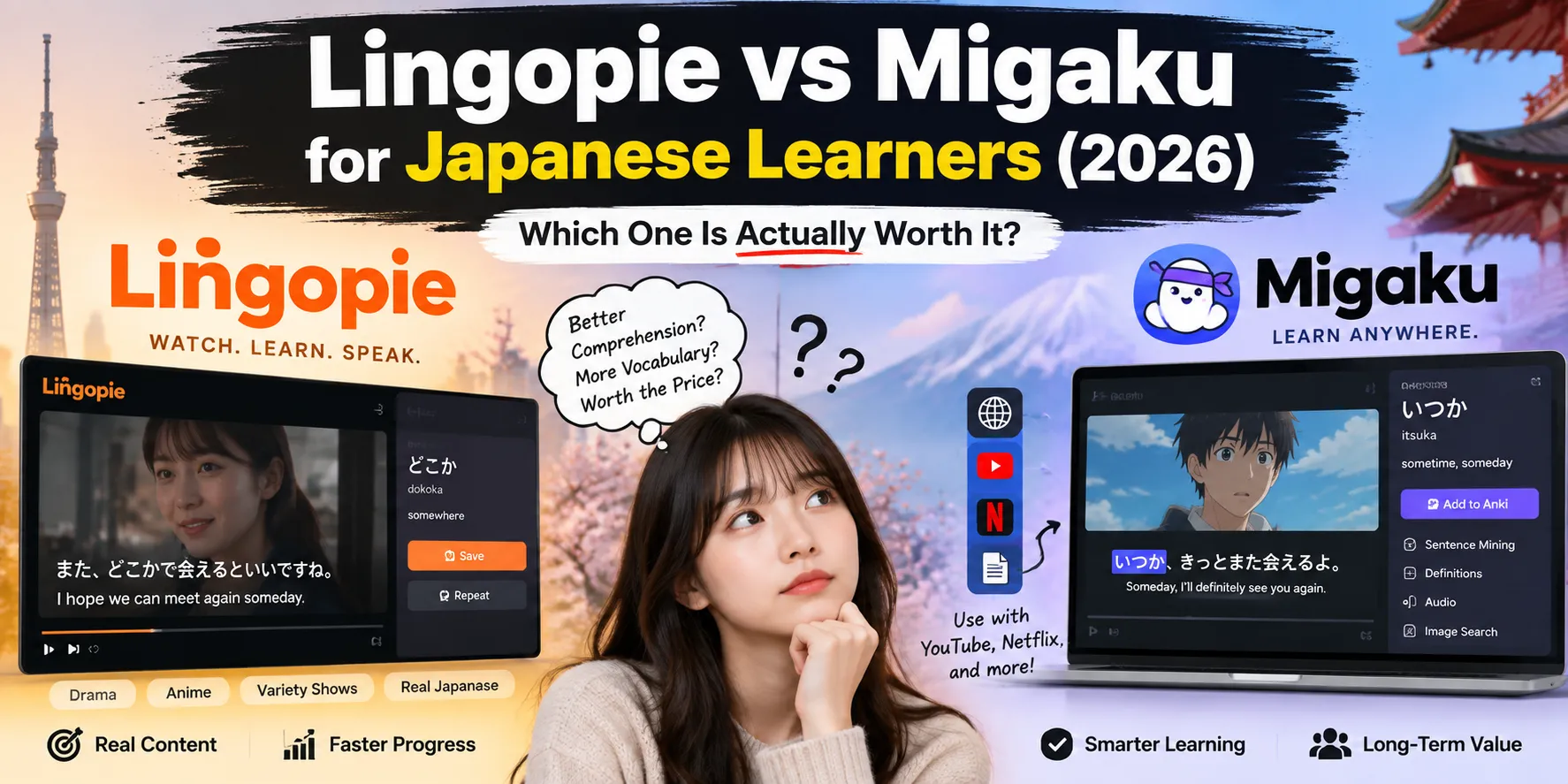
So you’ve been watching anime without subtitles and thinking, “I should really be learning something here.” Whether you’re a binge-watcher who wants to pick up Japanese naturally or a dedicated studier who wants to turn every episode into a vocabulary drilling session, you’ve probably landed on the Lingopie vs Migaku debate. Both promise to help you learn Japanese through content — but they work in completely different ways, and choosing the wrong one is an easy $100+ mistake to make.
I spent time testing both tools with real Japanese content to give you an honest side-by-side comparison. Here’s everything you need to know.
How I Tested These Tools

To keep this comparison fair, I ran both tools through the same scenario: a 20-minute Japanese anime clip on Netflix that I hadn’t seen before. I clicked the same set of words — including conjugated verbs like 食べました (ate), 行った (went), and 見ている (is watching) — and compared how each tool handled the lookup, what got saved to my flashcard deck, and how easy it was to actually review those cards afterward.
I also spent time with Lingopie’s own content library, browsing its beginner and intermediate Japanese catalog and using its built-in quiz and playback features separately from the Netflix test.
A few things I was specifically watching for:
- Does the tool correctly identify the base form of conjugated verbs? In Japanese this matters enormously — if your flashcard saves 食べました instead of 食べる, it’s basically useless.
- Is furigana (kana above kanji) available anywhere? For learners below N3, this is a non-trivial accessibility issue.
- How friction-free is the flashcard-to-review pipeline? A word lookup that never gets reviewed is just wasted attention.
With that context in mind, here’s what I found.
What Are Lingopie and Migaku?
Before diving in, it helps to understand what each tool actually is.
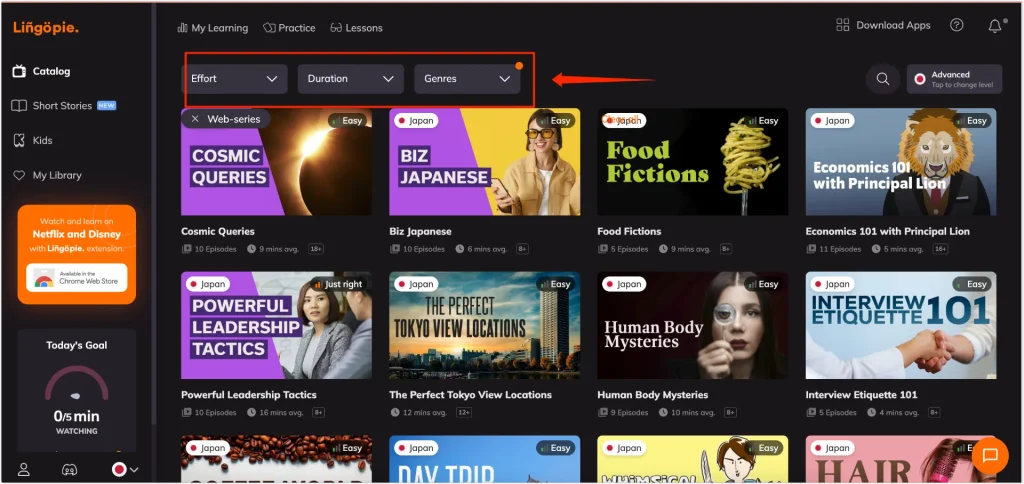
Lingopie is essentially a streaming platform built for language learners. Think of it as a Netflix-lite where all the shows come with built-in language learning features: dual subtitles, click-to-translate, flashcards, and quizzes. You pick a show, hit play, and the learning tools are baked right into the player.
Migaku is an immersion toolkit that attaches on top of platforms you already use — Netflix, YouTube, Disney+, and more. It’s a browser extension (plus mobile app) that adds instant word lookup, AI explanations, and one-click flashcard creation to any video content you’re watching. It also has its own SRS (spaced repetition system) called Migaku Memory, plus structured Japanese courses.
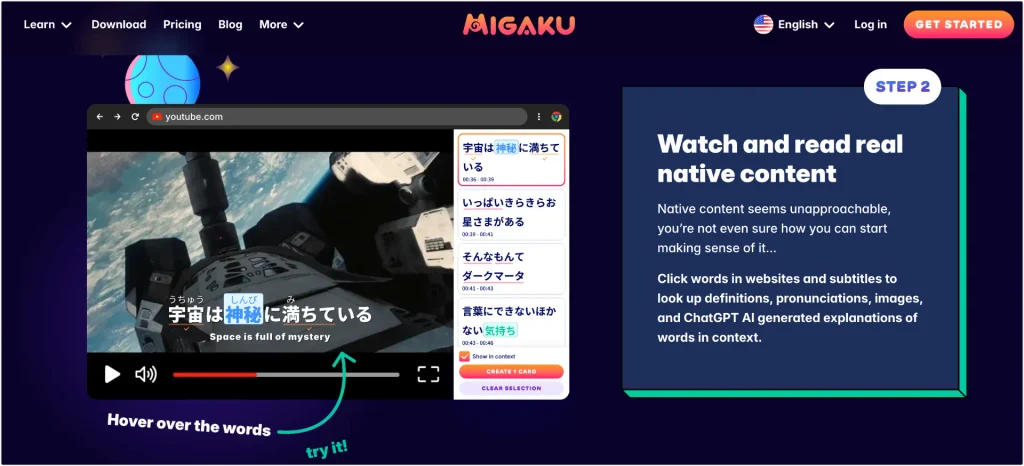
The short version: Lingopie is a platform. Migaku is a tool layer you add to the content you already watch.
Key Feature Comparison
| Feature | Lingopie | Migaku |
|---|---|---|
| Content library | ✅ Built-in (anime, dramas, podcasts, stories) | ❌ Use your own (Netflix, YouTube, etc.) |
| Dual subtitles | ✅ Yes | ✅ Yes (on supported platforms) |
| Click-to-translate | ✅ Yes | ✅ Yes (with AI explanations) |
| Furigana / kana hints | ❌ No | ✅ Yes (on lookup) |
| Conjugation handling | ❌ Weak | ✅ Strong |
| SRS flashcard system | ✅ Built-in (basic) | ✅ Full SRS (Migaku Memory) |
| Anki export | ❌ No | ✅ Yes |
| Beginner-level filters | ✅ Yes | ❌ Manual only |
| Browser extension | ❌ No | ✅ Yes |
| Mobile app | ✅ Yes (iOS/Android/TV) | ✅ Yes (iOS/Android) |
| Structured courses | ❌ Limited | ✅ Yes (Kana, grammar, kanji) |
| Playback speed control | ✅ Yes (0.65× – 1×) | ❌ Relies on platform |
| Pricing | ~$12/mo or ~$144/yr | $10/mo, $96/yr, or $499 lifetime |
| Free trial | 7-day | 10-day |
Content: Lingopie’s Biggest Advantage
If you don’t have Netflix or aren’t sure where to find Japanese content, Lingopie wins here by default. It has its own curated library of Japanese TV shows, anime, dramas, comedies, podcasts, short stories, and even audiobooks — all tagged by difficulty level. You can filter by “Beginner,” “Intermediate,” or “Advanced” and start watching immediately without hunting for content elsewhere.
Migaku has no content library of its own. You bring your own: your Netflix subscription, your YouTube watchlist, your Disney+ account. For a lot of learners this is actually a non-issue (you probably already have Netflix), but it’s worth knowing upfront — Migaku is a tool, not a service.
Winner: Lingopie — especially for beginners who want a ready-to-go experience.
Japanese Accuracy: Where Things Get Interesting
This is where the two tools diverge significantly — and it matters a lot for Japanese specifically.
Lingopie’s Japanese Parsing Issues
Japanese is notoriously hard to parse because words don’t have spaces between them, and verbs conjugate heavily. During testing, Lingopie’s click-to-translate had a recurring problem: it would grab particles along with words.
For example, clicking on ビールを飲みます (I drink beer) would sometimes save ビールを (beer + object marker を) as the flashcard word instead of just ビール (beer). This means your vocabulary list slowly fills with broken, particle-attached entries that are useless for actual study.
On top of that, Lingopie shows no furigana — no kana hints above kanji characters. If you’re at a beginner or early intermediate level, this makes the subtitles harder to follow than they need to be. Translations are AI-generated and can be awkward or inaccurate.
Migaku’s Lookup Quality
Migaku uses actual Japanese dictionaries combined with AI (ChatGPT-style explanations), and it handles verb conjugations smartly. Clicking 食べました (the polite past tense of “to eat”) correctly identifies 食べる as the base form and saves the card accordingly. The popup shows:
- The dictionary form of the word
- Furigana (kanji readings)
- An example sentence with context
- An AI-generated explanation
- Audio pronunciation
Cards created in Migaku are clean, linguistically accurate, and immediately useful.
Winner: Migaku — by a significant margin for Japanese specifically.
Flashcards and Review Systems
Lingopie Flashcards
Every word you click in Lingopie automatically gets added to your word list as a flashcard. The built-in review system includes multiple-choice vocabulary quizzes, a “Say It” speaking exercise, and a “Grammar Coach” feature that gives sentence-level explanations. It’s fun and approachable.
The downside: Lingopie’s flashcards are stuck inside Lingopie. You can’t export them to Anki or any other SRS. If you ever stop subscribing, you lose access to everything you’ve studied.
Migaku Memory (Full SRS)
Migaku’s SRS system is much more robust. One click creates a card with sentence context, audio, AI explanation, furigana, and even pitch accent data. Cards sync across the web and mobile app, and you can export to Anki or CSV if you prefer to study there instead.
If you’re someone who already uses Anki, Migaku slots right into your workflow. If you don’t, Migaku Memory works as a complete standalone system.
Winner: Migaku — especially if you take vocabulary review seriously or use Anki.
Ease of Use: Lingopie Keeps It Simple
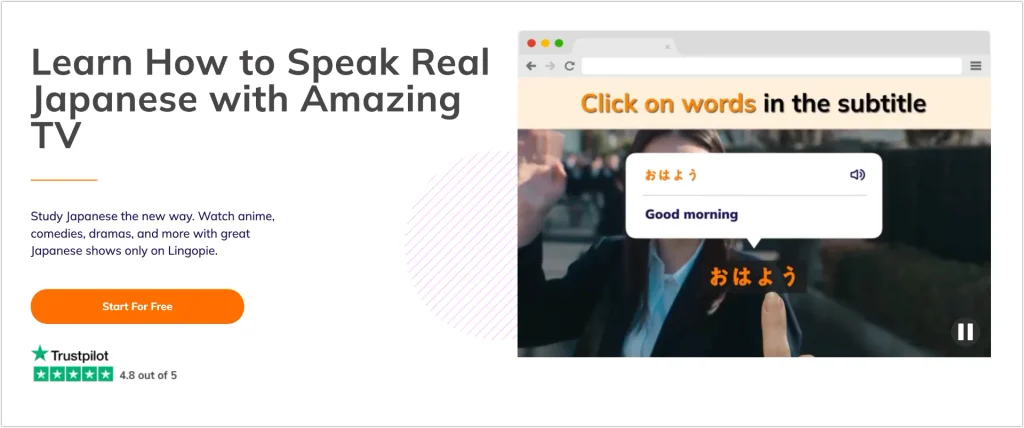
Here’s where Lingopie genuinely shines. The onboarding is seamless: sign up, pick a Japanese show, and start clicking words. There’s no extension to install, no setup process, no technical configuration. Everything is self-contained inside the Lingopie player.
Migaku has more power, but that comes with more complexity. You need to install the Chrome extension, link it to your streaming platforms, and learn how the SRS system works. For learners who just want to watch anime and absorb some vocabulary without a steep learning curve, Migaku’s setup can feel like homework before the actual homework.
Winner: Lingopie — for simplicity and plug-and-play experience.
Who Each Tool Is Really For
Choose Lingopie If…
- You’re a beginner or casual learner who wants to enjoy Japanese shows while picking up vocabulary naturally
- You want everything in one place — content, subtitles, flashcards, and quizzes — without managing multiple platforms
- You don’t have Netflix or don’t want to hunt for Japanese content yourself
- You learn best through fun, low-pressure exposure rather than structured drilling
- You want slow playback options (Lingopie lets you watch at 0.65× speed, which is huge for beginners)
Choose Migaku If…
- You’re serious about building Japanese vocabulary and want a reliable, accurate SRS pipeline
- You already watch anime or dramas on Netflix or YouTube and want to mine vocabulary from what you’re already watching
- You use or want to use Anki, and want your flashcards to integrate with it
- You’re targeting JLPT and want more systematic vocabulary and grammar coverage
- You don’t mind a learning curve in exchange for a more powerful tool
Lingopie vs Migaku by Learning Level
Generic “beginner vs advanced” breakdowns can feel vague, so here’s a more specific take based on where most Japanese learners actually find themselves.
Absolute Beginners (Just Starting Out)
If you don’t know hiragana yet, neither tool is a magic shortcut — you’ll need to learn the kana first, full stop. That said, Migaku has a structured beginner course that walks you through hiragana, katakana, and foundational grammar before you ever touch a video. Think of it as onboarding for immersion.
Lingopie doesn’t offer a kana course. It assumes you’ll learn to read through exposure, which works in some cases but can be frustrating when you’re clicking words you literally cannot read. What Lingopie does offer is slow playback (down to 0.65× speed) and beginner-filtered show selections, which remove the overwhelm of picking content yourself.
At this level: Start with Migaku’s beginner courses to build your kana and basic grammar foundation, then switch to Lingopie’s curated beginner shows for low-stakes listening practice once you can read hiragana.
Early Intermediate (Around N4–N3)
This is the level where immersion starts to click. You know enough grammar to follow simple sentences, and your listening is getting faster. Both tools become genuinely useful here.
Lingopie’s intermediate-tagged shows give you content that’s challenging but not discouraging. The click-to-translate function works well enough for common nouns and adjectives. The parsing problems are most noticeable with verbs — so if you’re mining vocabulary, stick to clicking nouns and set phrases rather than verb conjugations.
Migaku shines at this level because early intermediate learners typically encounter a huge number of unknown words per episode. Migaku’s one-click card creation with full sentence context means you can capture 10–15 new words per episode and actually review them later. The SRS ensures that words spiral back to you before you forget them.
At this level: Migaku is the better vocabulary-building investment. Use Lingopie for comfort watching — shows you want to enjoy without pressure.
Upper Intermediate to Advanced (N2 and Above)
At this point, you’re watching shows for enjoyment as much as study, and unknown words are a smaller percentage of each episode. This is where Lingopie becomes surprisingly pleasant — the learning friction is low, the content variety is solid, and the experience genuinely feels like watching TV rather than studying.
Migaku is still powerful for mining specific vocabulary (technical words, unusual expressions, regional dialect), but the pressure to review 50 cards a day starts to outweigh the fun for many learners at this level. The pitch accent trainer and grammar coach are still useful for fine-tuning.
At this level: Lingopie for daily immersion enjoyment; Migaku selectively when you want to go deep on new vocabulary domains.
JLPT-Focused Learners
If you’re actively studying for JLPT N3, N2, or N1, Migaku is the clearer choice. The structured SRS, Anki compatibility, and grammar breakdowns align much better with the kind of deliberate study that JLPT prep requires. You can mine vocabulary from content and feed it directly into a level-appropriate Anki deck.
Lingopie’s quiz system isn’t calibrated to JLPT vocabulary lists, and there’s no way to target specific grammar patterns. It can supplement your study as a listening tool, but it won’t replace a proper exam prep system.
Can You Use Both Lingopie and Migaku Together?
The short answer is yes — and for a certain type of learner, this is actually the ideal setup.
Here’s one way to think about it: Lingopie is your passive input time. Migaku is your active study time.
When you’re tired after work and just want to watch something in Japanese without thinking too hard, Lingopie is there with a pre-selected show at the right difficulty level. The dual subtitles keep you anchored, and clicking the occasional word keeps you semi-engaged. It’s the Japanese learning equivalent of reading a book in your target language on the couch.
When you sit down specifically to build vocabulary — maybe 20–30 focused minutes on a Saturday morning — you open Netflix with Migaku running. You watch more intentionally, pause to look up new words, create cards for anything useful, and then spend 10 minutes reviewing in Migaku Memory.
The two tools aren’t in competition. They serve different moments in a learning week. The only real caveat: Lingopie flashcards can’t be exported, so whatever vocabulary you save there lives only in Lingopie. If you’re serious about long-term vocabulary retention, Migaku (with its Anki export) is a more portable investment.
Pricing Breakdown
| Plan | Lingopie | Migaku |
|---|---|---|
| Monthly | ~$12/mo | ~$10/mo |
| Annual | ~$144/yr (often discounted to ~$72) | $96/yr |
| Lifetime | Occasionally available | $499 |
| Free Trial | 7 days | 10 days |
| Refund policy | Cancel anytime | 14-day money-back guarantee |
At face value, the pricing is similar. But Migaku’s $499 lifetime deal is worth considering if you’re in it for the long haul — it covers all languages, not just Japanese, so if you ever pick up Korean, Chinese, or Spanish, you’re covered.
One note on free trials: both require a payment method upfront. Lingopie users have reported difficulty canceling before the trial ends, so set a reminder.
The Verdict
| Lingopie | Migaku | |
|---|---|---|
| 🎯 Best for | 🎬 Casual learners, beginners, binge-watchers | 📚 Serious learners, JLPT studiers, SRS users |
| 🈶 Japanese accuracy | ⚠️ Weak (particle issues, no furigana) | ✅ Strong (dictionary + AI, conjugation-aware) |
| 📺 Content access | 🗂️ Built-in curated library | 🔗 Your own Netflix/YouTube |
| 🃏 Review system | 🎮 Basic quizzes | 🧠 Full SRS with Anki export |
| 🖱️ Ease of use | 😌 Very easy | 🔧 Moderate setup required |
| 💰 Value for money | 🛋️ Good for casual use | 💪 Better for active vocabulary building |
If your goal is to actually retain Japanese vocabulary and build fluency through immersion, Migaku is the stronger tool. Its pipeline — watch content, click unknown words, review with SRS — is well-designed, linguistically accurate, and built to scale with your level.
That said, Lingopie is genuinely enjoyable. If you’re an intermediate or advanced learner who just wants to consume Japanese content with a helpful safety net of translations and instant lookups, Lingopie makes that experience smooth and fun. It’s also a solid choice if you’re a complete beginner who wants access to leveled content without worrying about finding the right shows.
The best setup? Use both: Lingopie for curated, guided content time — especially when you want to relax and let Japanese wash over you — and Migaku when you’re in “study mode” and want every unfamiliar word to end up in a flashcard.
→ Read our full Lingopie Japanese review
Lingopie vs Migaku Frequently Asked Questions
Does Lingopie have a good Japanese anime selection?
Yes — Lingopie specifically markets its Japanese anime and J-drama catalog under categories like “Best of Japan” and “Best Cartoons.” The library isn’t as large as Netflix’s, but it’s curated for learners, which means you won’t accidentally click on something way above your level.
Can Migaku work with anime on YouTube?
Yes. Migaku works with YouTube as well as Netflix, Disney+, and Rakuten Viki. Most classic anime and many new releases have official YouTube channels with full episodes, so you can often find what you’re looking for without a Netflix subscription.
Do either of these tools show furigana on subtitles?
Lingopie does not show furigana anywhere — not on subtitles, not on flashcards. Migaku shows kanji readings when you look up a word through its popup, and exported Anki cards often include furigana as well. Neither tool overlays furigana on the running subtitles in real time.
Can I use Migaku on my phone?
Yes. Migaku has iOS and Android apps that support YouTube content and manually imported videos. However, some features — particularly Netflix integration — are Chrome extension only, meaning you’ll need a desktop browser for that. Lingopie has full iOS/Android apps and even smart TV support (FireTV, Roku).
Is Lingopie or Migaku better for Korean learners too?
Both tools support multiple languages beyond Japanese. Lingopie has a Korean content library with K-dramas and variety shows. Migaku supports Korean through its extension and courses. If you’re studying both Japanese and Korean (or thinking about it), Migaku’s single subscription covers all its supported languages — which arguably gives it better long-term value.
What happens to my Lingopie flashcards if I cancel?
You lose access. Lingopie’s vocabulary lists and flashcard data are tied to your account and subscription. There’s no export function, so if you cancel, everything you’ve saved disappears. This is one of the more significant reasons to think twice about using Lingopie as your primary vocabulary tool for serious study — Migaku’s export options mean your work travels with you.
Is there a permanent free version of either tool?
Neither offers a free tier. Both require a paid subscription after the trial period (7 days for Lingopie, 10 days for Migaku). Migaku’s 14-day money-back guarantee is more generous as a safety net if you decide it’s not for you after the trial.
Have you tried either Lingopie or Migaku for Japanese? Drop a comment below and let me know which one worked better for you — or if there’s another tool I should test next.