Key Takeaways
- To read Korean faster, train familiar words and grammar patterns until you recognize them as complete units instead of decoding every Hangul block.
- Practice with the Korean you actually want to read: subtitles, webtoons, comments, short articles, and sentences with long modifiers.
- Rereading is especially useful for speed. Read once for meaning, then return to the same text and see whether familiar chunks appear faster.
When I first started learning Korean, I thought reading would become fast as soon as I memorized Hangul. It didn’t.
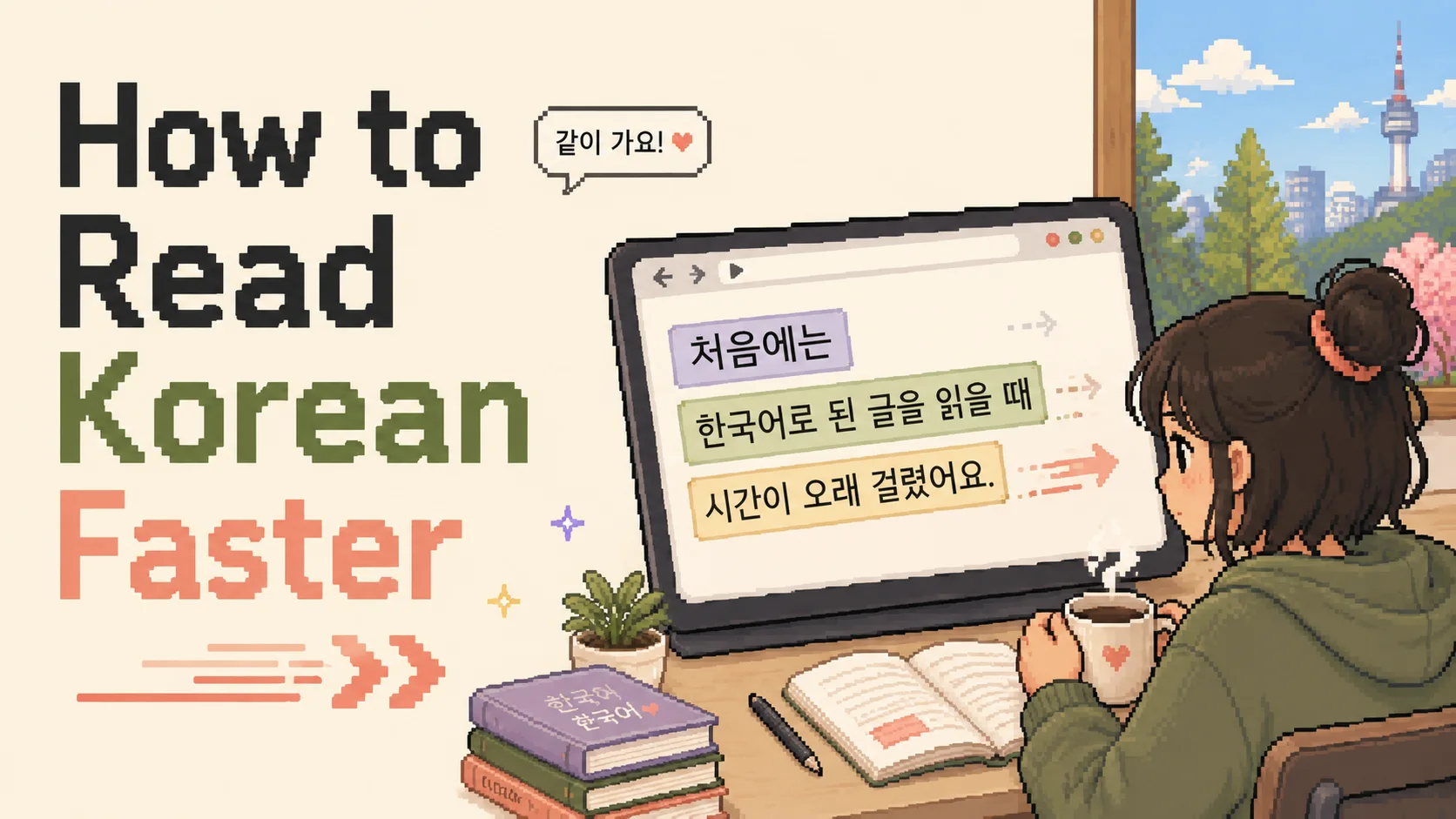
I could pronounce every syllable, but I was still reading so slowly that Korean subtitles disappeared before I finished them. Long sentences were even worse: by the time I reached the end, I had sometimes forgotten how the sentence started.
That was when I realized that learning how to read Korean faster was not really about memorizing Hangul better. I needed to stop decoding every familiar syllable and start recognizing whole words, grammar patterns, and chunks at a glance.
That is the shift this guide focuses on:
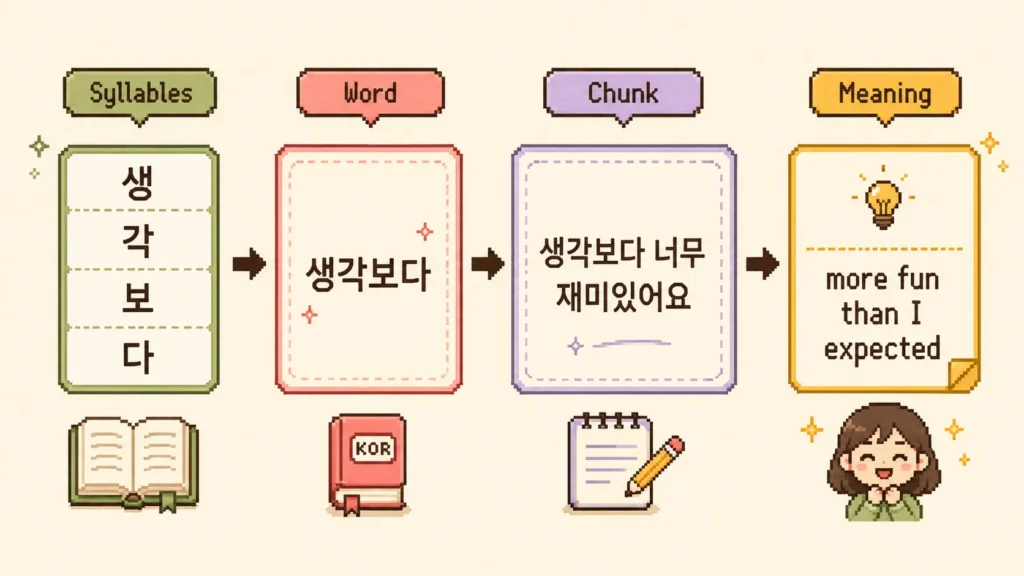
syllables → words → chunks → meaning
The Short Version
| If this happens… | Practice this |
|---|---|
| A Korean subtitle disappears before you finish | Timed subtitle reading |
| You know every word but still read slowly | Whole-word recognition |
| Long sentences make you forget the beginning | Meaning-based chunking |
| You get lost before the main noun appears | Long modifier practice |
| Webtoon dialogue looks harder than textbook Korean | Casual written Korean |
| Korean comments feel compressed or strange | Common internet patterns |
| News headlines take forever to decode | Headline chunking |
| Every new text feels equally slow | Reread familiar passages |
Reading faster does not mean forcing your eyes across the page. It means reducing how much conscious decoding familiar Korean requires.
Why Korean Reading Can Still Feel Slow After You Learn Hangul
Learning Hangul gives you the ability to decode Korean.
That is different from reading Korean fluently.
You may see:
생각보다
and still process:
생 / 각 / 보 / 다
before reaching the meaning more than I expected.
The same thing can happen with grammar.
You know all the pieces of:
그럴 수도 있을 것 같아요
but your brain still pauses at:
그럴 / 수도 / 있을 / 것 / 같아요
and reconstructs the grammar.
A faster reader sees increasingly large units:
생각보다
그럴 수도 있어요
그럴 수도 있을 것 같아요
The Korean has not become easier. Your recognition has become faster.
Why Long Korean Sentences Make This Worse
Consider:
처음에는 한국어로 된 기사를 읽는 데 시간이 너무 오래 걸려서 자주 포기하곤 했어요.
You may know every major word.
But if you process:
처음에는 / 한국어로 / 된 / 기사를 / 읽는 / 데 / 시간이 / 너무 / 오래 / 걸려서 / 자주 / 포기하곤 / 했어요
your brain has to hold too many separate pieces.
Now compare:
처음에는 / 한국어로 된 기사를 읽는 데 / 시간이 너무 오래 걸려서 / 자주 포기하곤 했어요.
That gives you four meaningful units:
- 처음에는 — at first
- 한국어로 된 기사를 읽는 데 — when reading articles written in Korean
- 시간이 너무 오래 걸려서 — because it took too long
- 자주 포기하곤 했어요 — I often used to give up
This is the shift you are trying to make throughout this guide.
1. Get Accurate at Decoding Before You Try to Go Fast
There is nothing wrong with sounding out Korean when a word is genuinely unfamiliar.
In fact, beginners should do it.
The problem starts when you are still consciously decoding words and expressions you have already seen hundreds of times.
Take:
어쩔 수 없어요
If it is new, slow down and read it accurately.
But once you already know the expression, continuing to process:
어 / 쩔 / 수 / 없 / 어 / 요
every time wastes attention that could be used for understanding the sentence.
The same applies to longer familiar words and phrases:
- 일상생활에서 — in everyday life
- 확인해 보겠습니다 — I’ll check
- 마찬가지예요 — it’s the same
- 관심이 생겼어요 — I became interested
- 생각보다 — more than expected
Ask yourself:
Did I understand the word as soon as I saw it, or did I have to finish pronouncing it first?
That is a much better reading-speed test than simply trying to move your eyes faster.
2. Train Whole Words and Grammar Patterns as Visual Units
If you want to know how to read Korean words faster, start by training familiar vocabulary and grammar patterns as complete visual units.
Vocabulary is only part of reading speed. Grammar needs to become automatic too.
Take:
할 수 있을 것 같아요.
A learner may understand every element but still read:
할 / 수 / 있을 / 것 / 같아요
one piece at a time.
Eventually, 할 수 있을 것 같아요 should begin to feel like a familiar pattern.
The same applies to:
- 그런 것 같아요
- 그럴 수도 있어요
- 할 수밖에 없어요
- 해야 할 것 같아요
- 생각해 본 적이 있어요
- 그렇게 된 것 같아요
- 그럴 줄 몰랐어요
You still need to understand how the grammar works. But you should not have to replay the grammar lesson in your head every time you encounter it.
Look at:
한국에서 살아 본 적이 없어서 잘 모르겠어요.
You could read:
한국에서 / 살아 / 본 / 적이 / 없어서 / 잘 / 모르겠어요
But once the grammar is familiar, this is easier:
한국에서 살아 본 적이 없어서 / 잘 모르겠어요.
The grammar itself has become part of the chunk.
If vocabulary is still slowing you down, my guide on how to learn Korean vocabulary goes deeper into learning words through context rather than isolated translations.
3. Learn to Survive Long Korean Modifiers
One of the biggest jumps from simple textbook Korean to real Korean is the amount of information that can appear before the noun.
For example:
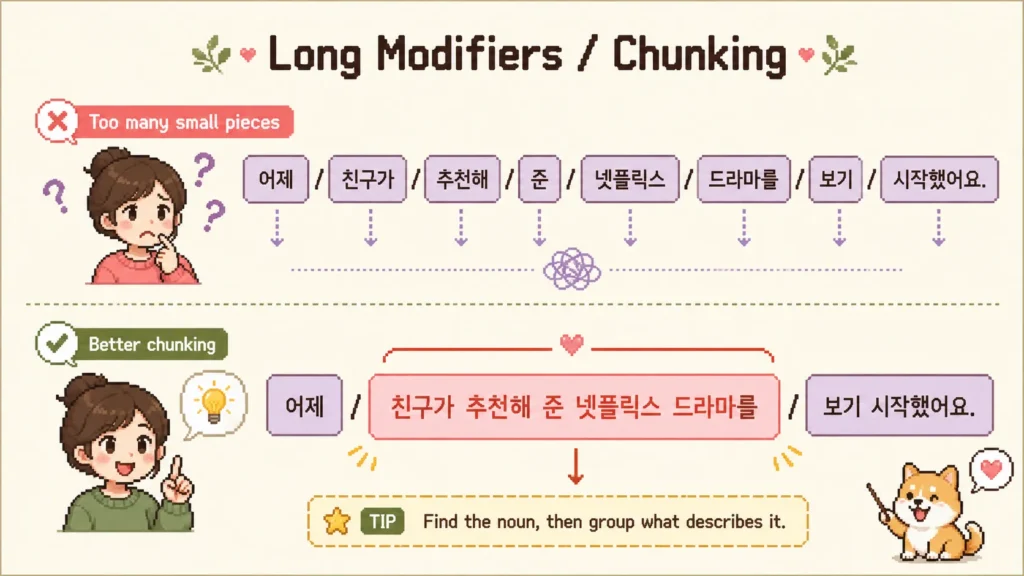
어제 친구가 추천해 준 넷플릭스 드라마를 보기 시작했어요.
You may begin with:
어제 / 친구가 / 추천해 / 준 / 넷플릭스…
and keep waiting for the sentence to tell you where all of this is going.
Then 드라마 finally appears.
A better way to read it is:
어제 / 친구가 추천해 준 넷플릭스 드라마를 / 보기 시작했어요.
The middle is one unit:
친구가 추천해 준 넷플릭스 드라마
the Netflix drama my friend recommended
Here is another:
제가 요즘 출퇴근할 때 자주 듣는 팟캐스트예요.
Instead of:
제가 / 요즘 / 출퇴근할 / 때 / 자주 / 듣는 / 팟캐스트예요
try:
제가 요즘 출퇴근할 때 / 자주 듣는 팟캐스트예요.
Or think of:
제가 요즘 출퇴근할 때 자주 듣는 / 팟캐스트
as:
the podcast I often listen to during my commute these days
Try a Harder One
지난주에 친구가 재미있다고 추천해 준 드라마를 주말 동안 다 봤어요.
First find the main action:
다 봤어요
I finished watching it.
Then identify the object:
드라마를
Then treat everything attached to the drama as one modifier:
지난주에 친구가 재미있다고 추천해 준 드라마
Now read:
지난주에 / 친구가 재미있다고 추천해 준 드라마를 / 주말 동안 다 봤어요.
You no longer have to keep six unrelated words floating in memory while waiting for the noun.
This skill matters constantly in Korean articles, reviews, subtitles, and TOPIK reading.
4. Read Korean in Meaningful Chunks, Not Word by Word
Now take a longer sentence:
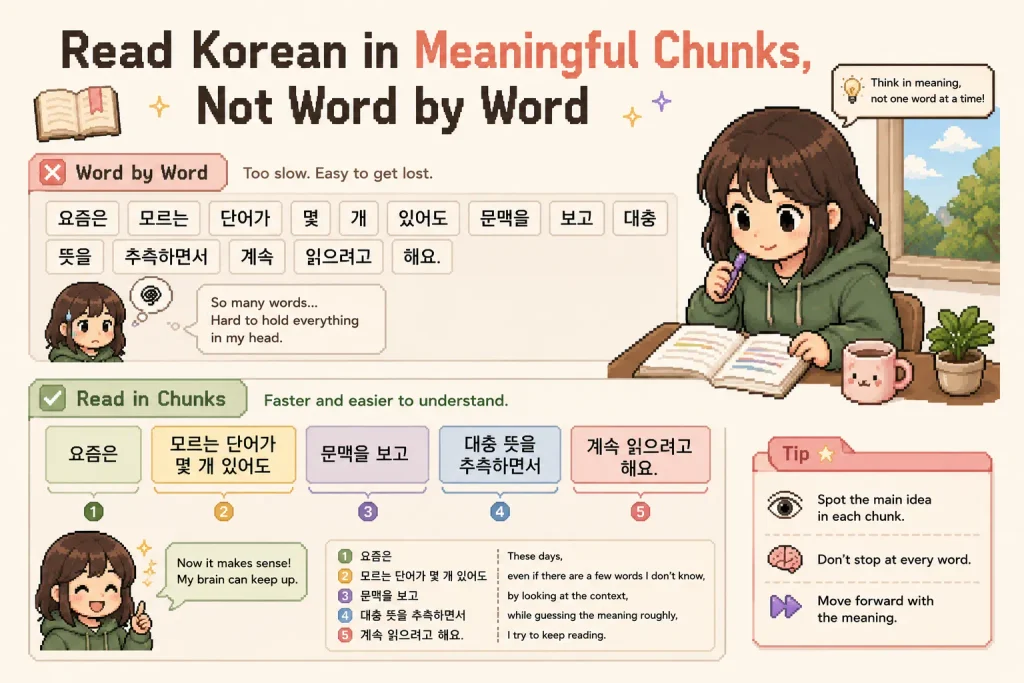
요즘은 모르는 단어가 몇 개 있어도 문맥을 보고 대충 뜻을 추측하면서 계속 읽으려고 해요.
These days, even if there are a few words I don’t know, I try to keep reading while roughly guessing the meaning from context.
Word by word:
요즘은 / 모르는 / 단어가 / 몇 / 개 / 있어도 / 문맥을 / 보고 / 대충 / 뜻을 / 추측하면서 / 계속 / 읽으려고 / 해요
That is a lot to hold.
Try:
요즘은 / 모르는 단어가 몇 개 있어도 / 문맥을 보고 / 대충 뜻을 추측하면서 / 계속 읽으려고 해요.
Now you have:
- these days
- even if there are a few unknown words
- looking at the context
- while roughly guessing the meaning
- I try to keep reading
Chunking does not mean inserting random pauses.
It means learning to see which Korean belongs together.
Another Sentence
처음에는 무슨 말인지 잘 몰랐는데 계속 보다 보니까 조금씩 이해가 되기 시작했어요.
Instead of:
처음에는 / 무슨 / 말인지 / 잘 / 몰랐는데 / 계속 / 보다 / 보니까…
read:
처음에는 / 무슨 말인지 잘 몰랐는데 / 계속 보다 보니까 / 조금씩 이해가 되기 시작했어요.
Expressions such as:
무슨 말인지 모르다
계속 보다 보니까
이해가 되기 시작하다
should gradually become recognizable units.
That is what makes longer Korean feel less mentally expensive.
5. Use Korean Subtitles as a Reading-Speed Test
One of the most practical reasons to read Korean faster is simple:
the subtitle disappears.
Try a natural subtitle-style sentence:
솔직히 처음에는 별로 기대 안 했는데 생각보다 너무 재미있는 거예요.
A slow reading process might look like:
솔직히 / 처음에는 / 별로 / 기대 / 안 / 했는데 / 생각보다 / 너무 / 재미있는 / 거예요
By the time you reach the end, the next subtitle may already be on screen.
Try grouping it instead:
솔직히 / 처음에는 별로 기대 안 했는데 / 생각보다 / 너무 재미있는 거예요.
Meaning:
Honestly, I didn’t expect much at first, but it was much more fun than I thought.
There are several chunks worth recognizing quickly:
- 솔직히
- 별로 기대 안 했는데
- 생각보다
- 재미있는 거예요
You do not need to consciously parse every particle before moving forward.
Can You Read This Korean Subtitle Before It Disappears?
Try this one without reading the translation first:
그때는 왜 그렇게까지 해야 하는지 잘 이해가 안 됐어요.
Give yourself a few seconds.
Did you read it like this?
그때는 / 왜 / 그렇게까지 / 해야 / 하는지 / 잘 / 이해가 / 안 / 됐어요
Now try:
그때는 / 왜 그렇게까지 해야 하는지 / 잘 이해가 안 됐어요.
Meaning:
At the time, I didn’t really understand why we had to go that far.
The middle:
왜 그렇게까지 해야 하는지
is one question embedded inside the larger sentence.
And:
잘 이해가 안 됐어요
is an extremely useful chunk to recognize without rebuilding it every time.
Use Audio to Pull Your Eyes Forward
Replay the matching Korean audio if you have it.
Follow the subtitle while the speaker talks and resist the urge to stop on one word.
Then read the same subtitle again without audio.
You may find that your eyes move through it faster because you have already heard how the sentence is grouped.
Korean YouTube videos with accurate Korean captions work particularly well for this. I have more options in my guide to Korean YouTube channels for language learners.
6. Practice With Webtoons and Korean Comments
Textbook Korean is useful, but it is not the only Korean you will want to read quickly.
Webtoons, comments, captions, and social posts often contain shorter sentences with much more conversational grammar.
Webtoon-Style Dialogue
Try:
아니, 내가 언제 그렇게 말했다고 그래? 그냥 좀 생각해 보겠다고 했잖아.
You might initially see:
아니 / 내가 / 언제 / 그렇게 / 말했다고 / 그래 / 그냥 / 좀…
Instead, recognize:
아니 / 내가 언제 그렇게 말했다고 그래? / 그냥 좀 생각해 보겠다고 했잖아.
Two useful chunks are:
내가 언제 그렇게 말했다고 그래?
When did I ever say that?
and:
생각해 보겠다고 했잖아.
I said I’d think about it, remember?
Patterns such as -다고 하다, -잖아, and -겠다고 하다 appear constantly in conversational Korean.
If you have to stop and reconstruct each grammar point every time, a Webtoon panel will feel much harder than it actually is.
Korean Comment-Style Writing
Now look at:
처음엔 별생각 없이 봤는데 보다 보니까 완전 빠져들었음.
This is closer to the compressed style you might see in a Korean comment than formal textbook prose.
Chunk it:
처음엔 별생각 없이 봤는데 / 보다 보니까 / 완전 빠져들었음
Roughly:
I started watching without thinking much of it, but the more I watched, the more I got completely hooked.
Notice -음 at the end.
You may have learned 빠져들었어요, but online Korean frequently uses noun-style endings such as -음 / -ㅁ in comments and informal written reactions.
Reading faster therefore also means becoming familiar with the forms that appear in the places you actually read Korean.
The goal is not to memorize every piece of internet slang.
It is to stop expecting every real Korean sentence to look like a textbook dialogue.
7. Learn to Read Korean News Headlines as Chunks
News creates a different reading problem.
Headlines are compressed.
Particles may disappear, vocabulary becomes denser, and several nouns can appear together.
Consider:
정부, 청년 주거비 부담 완화 위한 지원 확대
The government is expanding support to ease the housing cost burden on young people.
Reading one syllable at a time makes this painful.
Start by finding the largest concepts:
정부
government
청년 주거비 부담 완화
reducing young people’s housing-cost burden
지원 확대
expansion of support
Now read:
정부 / 청년 주거비 부담 완화 위한 / 지원 확대
You can understand the headline before converting it into a perfect English sentence.
That is an important reading skill.
Another Headline-Style Example
외국인 관광객 증가로 서울 주요 관광지 방문객 급증
Find:
외국인 관광객 증가로
due to an increase in foreign tourists
서울 주요 관광지
major tourist attractions in Seoul
방문객 급증
sharp rise in visitors
Then:
외국인 관광객 증가로 / 서울 주요 관광지 / 방문객 급증
News reading becomes much easier once you stop treating every noun as an isolated vocabulary test.
It is also useful TOPIK practice because you learn to identify the information structure quickly before worrying about every detail.
Read One Realistic Korean Paragraph Three Times
Single sentences are useful, but the real challenge is opening a paragraph and not immediately feeling overwhelmed.
Try this:
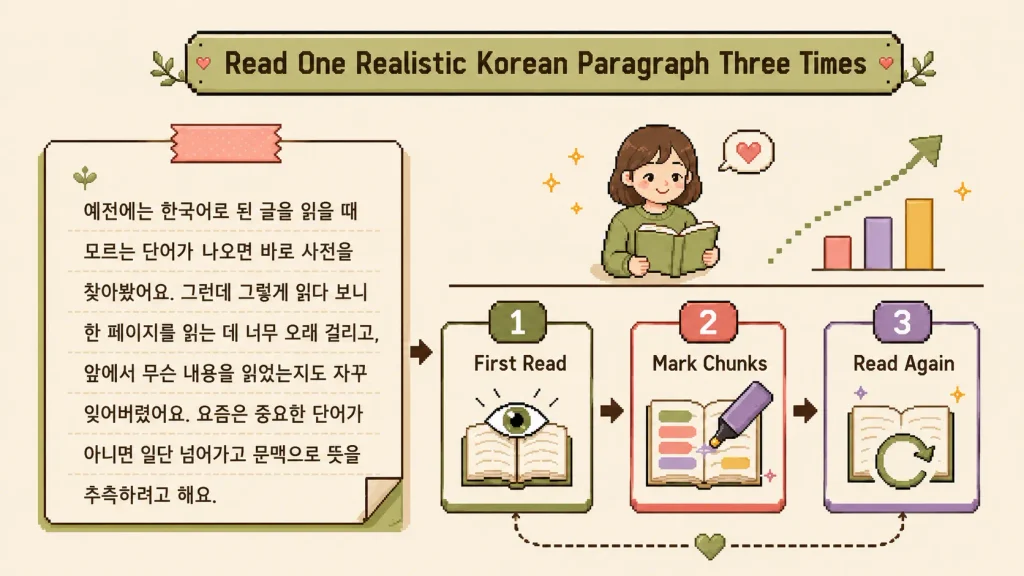
예전에는 한국어로 된 글을 읽을 때 모르는 단어가 나오면 바로 사전을 찾아봤어요. 그런데 그렇게 읽다 보니 한 페이지를 읽는 데 너무 오래 걸리고, 앞에서 무슨 내용을 읽었는지도 자꾸 잊어버렸어요. 요즘은 중요한 단어가 아니면 일단 넘어가고 문맥으로 뜻을 추측하려고 해요.
Previously, whenever I came across an unknown word while reading Korean, I would look it up in the dictionary right away. But reading that way took forever to get through even one page, and I kept forgetting what I had read earlier. These days, unless it’s an important word, I just move on and try to guess the meaning from context.
First Reading: Just Understand It
Do not time yourself yet.
Notice where you slow down.
Possible trouble spots:
- 한국어로 된 글
- 모르는 단어가 나오면
- 그렇게 읽다 보니
- 한 페이지를 읽는 데
- 앞에서 무슨 내용을 읽었는지도
- 일단 넘어가고
- 문맥으로 뜻을 추측하려고 해요
Second Reading: Mark the Chunks
Now try:
예전에는 / 한국어로 된 글을 읽을 때 / 모르는 단어가 나오면 / 바로 사전을 찾아봤어요.
그런데 그렇게 읽다 보니 / 한 페이지를 읽는 데 너무 오래 걸리고 / 앞에서 무슨 내용을 읽었는지도 / 자꾸 잊어버렸어요.
요즘은 / 중요한 단어가 아니면 일단 넘어가고 / 문맥으로 뜻을 추측하려고 해요.
The paragraph has not changed.
But you have reduced the number of separate decisions your brain has to make.
Third Reading: Do Not Stop
Now read the whole paragraph again.
Do not look up anything.
Pay attention to what changed.
Did 읽다 보니 appear immediately?
Did 한 페이지를 읽는 데 feel like one unit instead of several separate pieces?
Could you reach the end of the second sentence without forgetting the beginning?
That is the kind of improvement that matters.
A Simple 10-Minute Korean Reading Routine
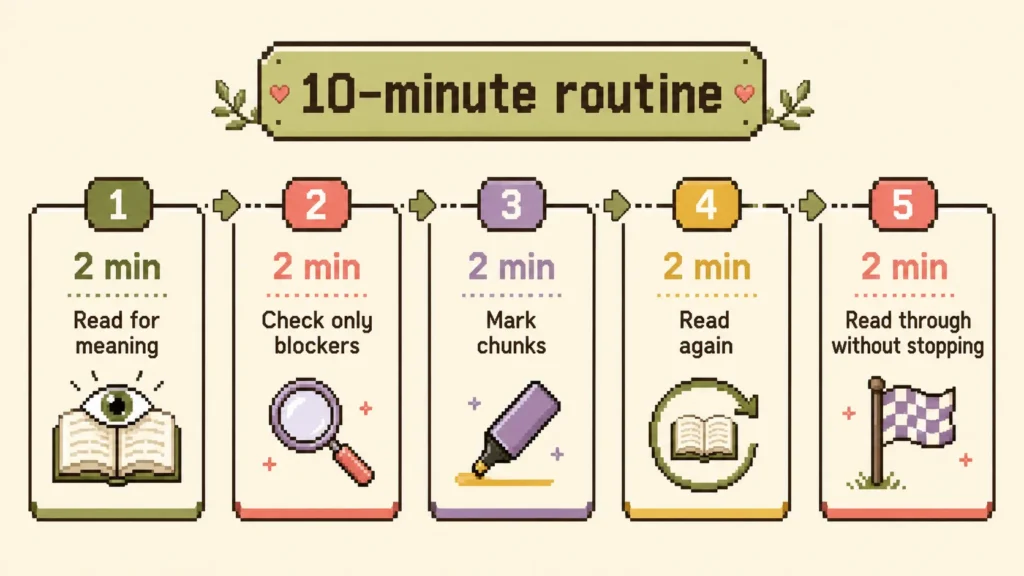
You do not need an hour of speed drills.
Use one short subtitle sequence, Webtoon section, paragraph, or news story.
| Time | What to do |
|---|---|
| 2 min | Read once for meaning |
| 2 min | Check only what blocks understanding |
| 2 min | Mark natural chunks |
| 2 min | Read again, ideally with audio if available |
| 2 min | Read from beginning to end without stopping |
For the final pass, do not obsess over your exact speed.
Ask:
- Did familiar grammar appear faster?
- Did I pause fewer times?
- Did I see larger chunks?
- Did I still understand the sentence?
That is a better measure than racing through Korean without retaining anything.
Try the Day 1, Day 3, Day 7 Reading Test
Use the same passage three times.
For example:
최근에는 한국어 공부를 위해 일부러 짧은 뉴스 기사나 블로그 글을 읽고 있어요. 처음에는 한 문장을 읽는 데도 시간이 오래 걸렸지만, 같은 표현을 여러 번 보다 보니 조금씩 읽는 속도가 빨라졌어요. 아직 모르는 단어가 많아도 예전처럼 모든 단어를 사전에서 찾지는 않아요.
Day 1
Read it once and time yourself.
Do not race.
Mark where you hesitate.
Maybe:
한국어 공부를 위해
한 문장을 읽는 데도
여러 번 보다 보니
예전처럼
Day 3
Read the exact same paragraph again.
Did:
여러 번 보다 보니
now register faster as one grammar pattern?
Did you immediately recognize:
읽는 속도가 빨라졌어요
instead of working through each word?
Day 7
Read it one final time.
Compare:
- total time
- number of pauses
- comprehension
- number of chunks you recognized immediately
Real progress is:
faster recognition + fewer pauses + retained meaning
How to Know Your Korean Reading Is Getting Faster
You do not need to calculate words per minute every day.
Look for these changes:
- Korean subtitles disappear less often before you finish.
- Common expressions appear instantly familiar.
- You stop consciously pronouncing every Hangul block.
- Long modifiers no longer feel like random strings of words.
- You recognize grammar such as -다 보니까 or -ㄴ 것 같아요 as patterns.
- You can read a Webtoon panel without translating every line.
- Korean comments look less strange.
- News headlines become easier to divide into information chunks.
- You reach the end of a long sentence without forgetting the beginning.
- Rereading feels noticeably smoother than the first pass.
A particularly important milestone is realizing that you understood a Korean expression before consciously sounding it out.
That is automatic recognition taking over.
Common Mistakes That Keep Korean Reading Slow
Trying to Read Fast Before Hangul Is Stable
Speed should not come at the cost of accuracy.
If you are still regularly misreading vowels or 받침, keep practicing careful decoding first.
Using Only Difficult Native Material
A difficult Korean news article may be excellent vocabulary practice and terrible speed practice.
Use challenging material to expand your Korean.
Use easier or familiar material to build automaticity.
Looking Up Every Unknown Word
One unknown word does not always stop you from understanding a sentence.
Constant dictionary use breaks reading flow and trains you to stop whenever you feel uncertain.
Try to finish the sentence or paragraph first.
Translating Everything Into English
At first, translation is useful.
But eventually:
한국어 → English → meaning
needs to become more often:
한국어 → meaning
The faster that connection becomes, the easier reading feels.
Never Reading the Same Thing Twice
New texts test your current reading ability.
Familiar texts let you practice speed.
You need both.
Final Thoughts
When I first started reading Korean, I thought the answer was to keep learning more words and harder grammar. But the more I read, the more I noticed that speed often came from seeing the same Korean again until I no longer had to decode it.
The progression I now try to build is:
syllables → words → grammar patterns → chunks → meaning
I follow Korean with Ina, and one idea from her videos that really stayed with me is Repeat → Automate. I am not sponsored — it is simply a study idea I found useful.
So now, instead of always reaching for a harder text, I also reread subtitles, sentences, and short paragraphs I already understand. If a phrase like -다 보니까, -ㄴ 것 같아요, or 할 수밖에 없다 starts appearing as one unit instead of several grammar pieces, that is progress.
Sometimes reading faster is not about learning more Korean. It is about needing less effort to recognize the Korean you already know.
How to Read Korean Faster FAQs
Why can I read Hangul but still read Korean slowly?
Knowing Hangul means you can decode Korean writing. Fluent reading requires you to recognize familiar vocabulary, grammar, and chunks without consciously decoding every syllable.
That automatic recognition develops through repeated exposure and rereading.
How can I read Korean words faster?
To read Korean words faster, practice with vocabulary you already know instead of constantly using new words.
The goal is to recognize familiar words and expressions such as 생각보다, 어쩔 수 없어요, or 일상생활에서 as complete visual units rather than decoding each Hangul block separately.
Rereading the same short text also helps. Each repeat gives your brain another chance to recognize familiar Korean immediately instead of sounding it out again.
How can I read Korean subtitles faster?
Practice with short scenes you already understand.
Read the Korean subtitles once at your own speed, replay the scene while following the audio, then watch again without pausing. Familiar scenes work well because you can focus on reading instead of figuring out the plot.
You can also practice with shows from my guide to the best K-dramas to learn Korean.
Why do long Korean sentences feel so difficult?
Korean often places modifiers before nouns and important sentence-ending information later than English.
If you read every word independently, working memory gets overloaded. Learning to group expressions such as 친구가 추천해 준 드라마 into meaningful chunks reduces that load.
Are Webtoons good for Korean reading practice?
Yes, especially once basic grammar is comfortable.
Webtoons give you short conversational lines, visual context, casual endings, reactions, and expressions that appear frequently in spoken Korean. They are also less intimidating than opening a full page of dense prose.
Should I read Korean out loud?
Reading aloud is useful for decoding and noticing hesitation.
For pure reading speed, you should also practice silent reading. Silent reading can eventually move faster because you do not need to physically pronounce every syllable.
Does vocabulary size affect Korean reading speed?
A lot.
Unknown words force you to stop or guess. Familiar words can eventually be recognized almost instantly, which frees up attention for understanding the sentence as a whole.
Should I practice Korean reading with news?
Yes, but choose it for the right reason.
News is useful for formal vocabulary, compressed headlines, and TOPIK-style information processing. If you are still decoding most words individually, easier material may be better for pure speed training.