This post contains affiliate links. I may earn a commission if you make a purchase through them, at no extra cost to you.
Key Takeaways
- The most effective way to improve Korean listening is to combine short active listening sessions — including dictation and transcript checking — with regular easier listening for volume.
- Passive exposure, like watching K-dramas with English subtitles, builds familiarity but does not train your ear to catch words automatically. Active listening helps close that gap.
- Consistent short sessions using one or two familiar sources will usually help more than collecting new resources and constantly switching between them.
If you are wondering how to improve Korean listening, the frustrating part is that you can know the vocabulary and grammar but still struggle with normal-speed Korean.
Spoken Korean connects sounds and reduces endings, so the best practice combines focused listening, dictation, transcripts, shadowing, and easier listening for volume.
The Short Version
| If you struggle with… | Try this |
|---|---|
| Korean sounds impossibly fast | Practice short clips and connected speech |
| You know the words but cannot hear them | Dictation + transcript checking |
| You depend on subtitles | Switch between Korean subtitles and no subtitles |
| You forget the start of long sentences | Practice in short chunks |
| K-dramas are not improving your listening | Rewatch scenes with a specific listening task |
| You keep changing resources | Stick with one or two sources |
| Formal Korean is easier than real conversations | Add vlogs and variety shows |
| You recognize words only when reading | Learn vocabulary with audio and full sentences |
You do not need to use every method every day. A short active listening session plus regular easier listening is enough to build a much better routine.
Why Korean Listening Feels So Hard
One reason Korean listening becomes frustrating around the intermediate level is that your reading ability can improve much faster than your ability to recognize the same language in speech.
You look at a sentence and understand it immediately. Then someone says the exact same sentence and it seems to disappear.
Written Korean and Spoken Korean Do Not Always Sound the Same
Hangul is wonderfully systematic, but that does not mean every Korean word sounds exactly the way a learner expects from its spelling.
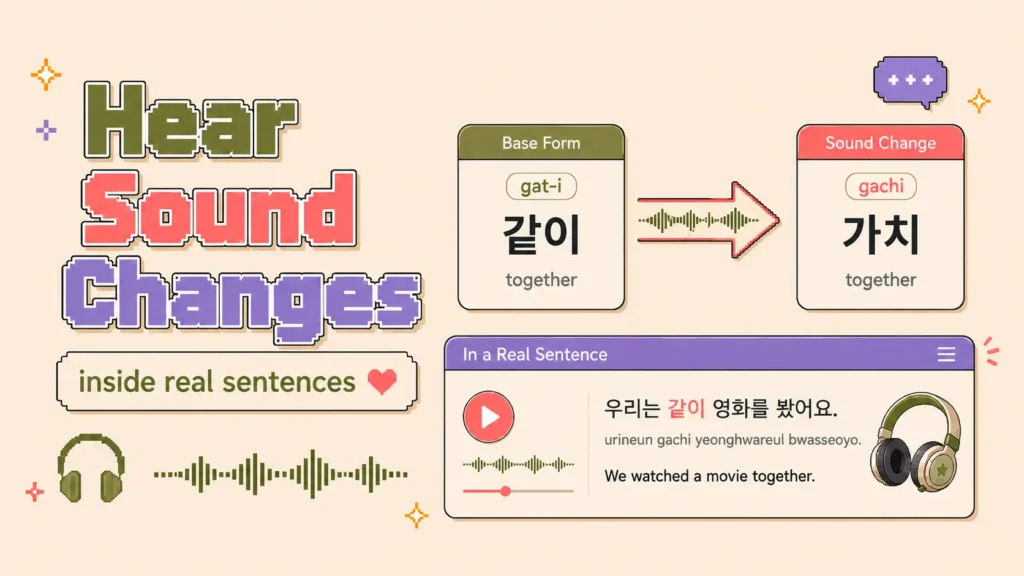
Sounds interact with the syllables around them. 받침 changes, consonants become stronger, sounds connect across syllable boundaries, and familiar words can sound surprisingly different in natural speech.
A simple example is:
같이 → [가치]
You may know 같이 perfectly well on paper and still fail to recognize it the first few times you hear it inside a fast sentence.
This is why memorizing another list of pronunciation rules is not always enough. You need repeated exposure to those sound changes inside real sentences.
Knowing a Word Is Different From Hearing It Automatically
Imagine you hear a word, mentally replay it, remember its dictionary form, translate it, and finally understand it.
That process may work during a slow textbook recording. In a real conversation, the speaker has already finished another sentence.
Strong listening depends on increasingly automatic recognition.
You want to move from:
hear → decode → translate → understand
toward:
hear → understand
That transition takes repeated listening to language you already mostly know.
This is also why learning Korean vocabulary should include pronunciation and sentences, not only flashcards with Korean on one side and English on the other.
Your Brain Is Trying to Hold Too Much at Once
Long Korean sentences can also create a memory problem.
If you are still decoding the first half of the sentence when the speaker reaches the end, the whole sentence starts to feel too fast. You may actually know most of the words but cannot process them quickly enough as one continuous message.
Short listening chunks help because they give your brain time to build automatic recognition before you increase the length.
Passive Listening vs. Active Listening: You Need Both
Listening to Korean while commuting, cleaning, or cooking is useful.
It helps Korean rhythm feel more familiar. You get used to common endings, voices, intonation, and natural speed. Longer listening sessions also build stamina.
But background listening is mostly exposure.
Active listening is different because you give yourself a task.
You might try to write down exactly what you hear, identify a missed sound change, compare a sentence with a transcript, or repeat a difficult line until you can follow it naturally.
A useful way to think about it is:
Background listening gives you exposure. Active listening shows you what your ears are actually missing.
You need both.
The problem starts when someone watches hundreds of hours of Korean content with English subtitles and expects that exposure alone to turn into strong listening comprehension.
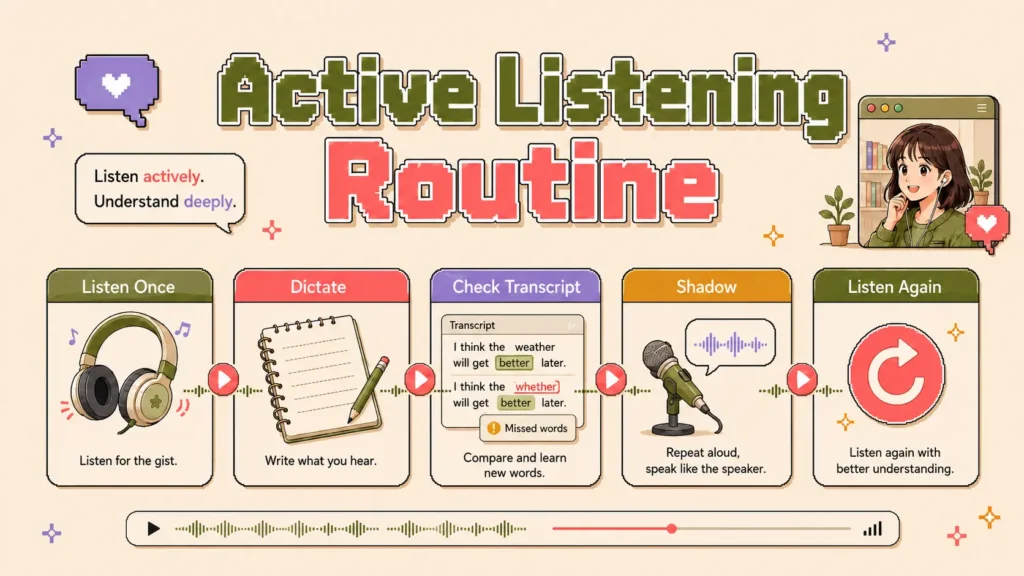
1. Use This 4-Step Active Listening Routine
If you only take one method from this guide, use this one.
You need a short Korean clip with an accurate Korean transcript or subtitles. Podcasts, interviews, news clips, learner audio, YouTube videos, and short drama scenes can all work.
Start with about 30 seconds to two minutes. You do not need to dissect an entire 40-minute podcast episode.
Step 1: Listen Once Without Pausing
Play the entire section once at normal speed.
Do not pause. Do not open the transcript. Do not immediately look up the word you think you heard.
Ask yourself:
- What is the topic?
- How much can I understand?
- Where does my comprehension suddenly disappear?
This first listen gives you a realistic baseline.
Step 2: Replay It in Short Chunks and Write What You Hear
Now divide the audio into roughly five- to ten-second sections.
Listen and write down what you hear in Korean.
Leave blanks when you cannot hear something. Do not turn the exercise into a guessing game based on grammar.
This is dictation, or 받아쓰기, and it is one of the clearest ways to diagnose a listening problem.
It can be surprisingly uncomfortable.
You may feel that you understood a sentence until you try to write it down. Suddenly you realize you missed a particle, a verb ending, or half of a phrase.
That is exactly why the exercise works.
Step 3: Check the Korean Transcript
Now compare your version with the real sentence.
You do not need to highlight everything. I would focus on only two categories.
1. Words you already knew but failed to hear
These are often the most valuable mistakes.
Ask what happened. Was there liaison? A 받침 change? A reduced pronunciation? Did several familiar words blur together?
2. Words or phrases you genuinely did not know
These belong in your vocabulary study.
This simple distinction stops every listening session from turning into a giant vocabulary-mining project.
Step 4: Shadow the Difficult Lines and Listen Again
Take the sentences you marked and play them again.
Repeat along with the speaker out loud. Try to match the rhythm and connected pronunciation rather than reading every Hangul syllable separately.
You do not have to shadow the entire recording ten times. Focus on the lines that caused trouble.
Then listen to the original section once more without looking at the transcript.
The complete cycle is:
listen → dictate → diagnose → shadow → listen again
That is what active listening can look like in practice.
2. Learn Korean Sound Changes Inside Full Sentences
It is useful to learn Korean pronunciation rules, but listening practice becomes much more effective when you connect those rules to moments when your ear actually failed.
Suppose you miss a word because its pronunciation changed inside a sentence.
Instead of saving only that word, save the whole sentence.
Listen to it several times. Read it aloud. Then return to the original audio.
You are training your brain to recognize:
this written sequence → this spoken sound
The goal is not to become someone who can name every Korean phonological rule. The goal is to stop being surprised when familiar Korean changes shape in natural speech.
Keep a small list of recurring problems rather than studying everything at once.
For example:
- liaison and connected pronunciation
- 받침 changes
- tense consonants
- reduced casual endings
- words that repeatedly blend together
Once you start noticing the same pattern in different sentences, natural Korean becomes much less blurry.
3. Learn Korean Vocabulary With Your Ears, Not Just Your Eyes
A listening problem is sometimes a vocabulary problem in disguise.
You may recognize a word instantly in a flashcard deck or textbook but never have built a strong memory for what it sounds like in a sentence.
When you learn a new Korean word, try to do three things:
- Hear it.
- Say it out loud.
- Hear it inside at least one complete sentence.
This is particularly useful for common phrases and collocations.
You do not want to recognize only a dictionary entry. You want to recognize the sound pattern that appears when Koreans actually use it.
For example, learning several words together as a familiar phrase can make listening much easier than processing every word separately.
Over time, you stop hearing five independent words and start hearing one meaningful chunk.
If vocabulary itself is slowing you down, my guide on how to learn Korean vocabulary goes deeper into learning words through context instead of memorizing isolated translations.
4. Use Korean Transcripts Before Reaching for English Subtitles
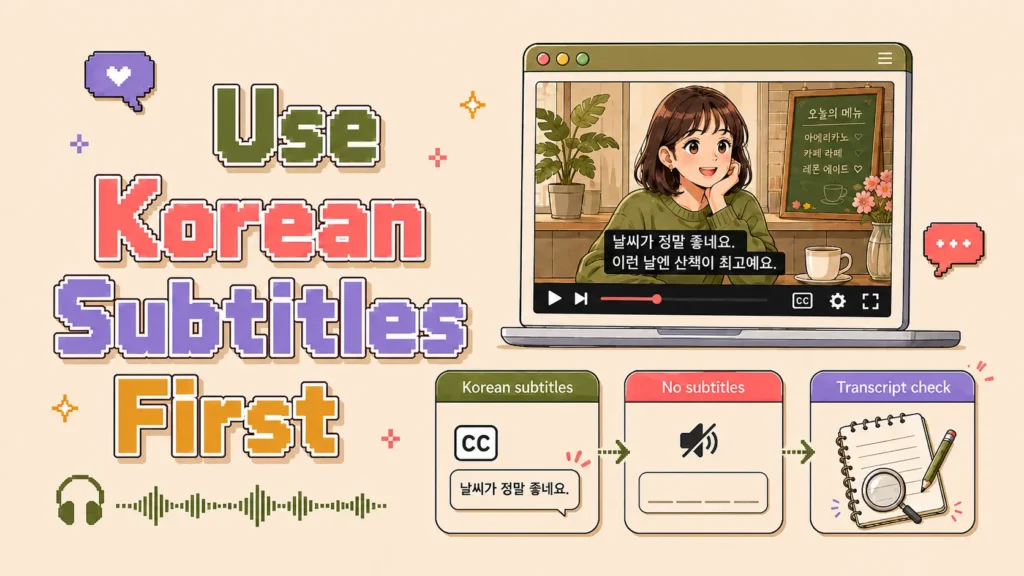
Subtitles are not automatically bad for listening practice.
The question is which subtitles you use and when you use them.
English subtitles make a show easy to enjoy, but your brain can bypass much of the Korean audio because the meaning is already available in English.
Korean subtitles work differently.
They can help connect the sounds you hear with the Hangul you already know.
A useful progression is:
Korean audio + Korean subtitles
↓
Korean audio without subtitles
↓
Korean transcript for checking
You do not need to force yourself to watch an entire episode without support.
Use subtitles as scaffolding, then remove them for a short section you want to train.
This is especially useful when moving from learner audio to native content.
5. Try the Three-Pass Method With K-Dramas
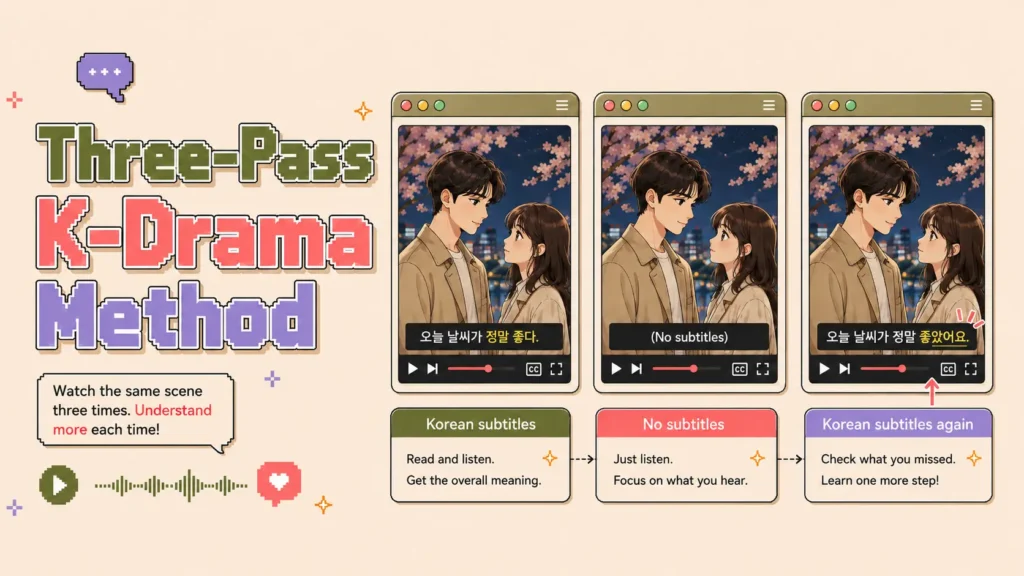
K-dramas can absolutely be useful for Korean listening.
The problem is usually not the drama itself. It is how you watch it.
Watching a new episode once with English subtitles is entertainment with Korean exposure. That is fine, but it is different from focused listening practice.
For a scene you want to study, try three passes.
First Pass: Watch With Korean Subtitles
Understand the scene first.
Knowing what is happening reduces the amount of information your brain has to process during the next listen.
Notice a few useful phrases, but do not stop every five seconds.
Second Pass: Turn the Subtitles Off
Replay the same scene without subtitles.
Now pay attention to what your ear can catch.
Listen for:
- familiar words
- sentence endings
- repeated phrases
- connected sounds
- places where the audio sounds different from what you expected
Do not worry about understanding every line.
Third Pass: Turn Korean Subtitles Back On
Check the places you missed.
This is usually the most interesting part because you can finally compare:
what I thought I heard
with:
what they actually said
Choose short scenes rather than turning an entire episode into homework.
You can also start with a familiar show. Knowing the characters and story makes it easier to focus on the language instead of constantly figuring out what is happening.
For more options, I have a separate guide to the best K-dramas to learn Korean.
6. Choose Korean Listening Material You Can Mostly Follow
Harder does not automatically mean better.
If you understand almost nothing during a 30-minute native podcast, you have very little language to attach new sounds to. You may get useful exposure to rhythm, but it is difficult to do focused comprehension work.
At the other extreme, audio that you understand perfectly may not give your listening system anything new to solve.
A practical middle ground is:
You should miss things, but you should still know what is happening.
Different materials are useful for different listening goals.
| Your goal | Good listening material |
|---|---|
| Clear formal pronunciation | KBS or MBC news |
| Everyday casual Korean | Vlogs |
| Reactions and natural conversation | Variety shows |
| Controlled intermediate listening | Learner podcasts |
| Rewatchable contextual listening | Familiar K-dramas |
| Focused sound-to-text practice | Audio with Korean transcripts |
News can be particularly useful when you want clear pronunciation and formal vocabulary.
For casual spoken Korean, vlogs often give you something dramas do not: ordinary people talking about normal things in a less scripted setting.
Variety shows add interruptions, reactions, joking, fillers, and faster conversational turns. They can be challenging, but they are useful once learner material starts feeling too controlled. If you are not sure where to start, I have a guide to the best Korean variety shows to learn Korean with recommendations by level.
You can also find more listening material in my guide to Korean YouTube channels for language learners.
Most importantly, do not collect too much.
You do not need ten podcasts, five dramas, three apps, and a folder full of YouTube playlists.
One podcast and one video source you return to every week can teach you far more than constantly searching for the “perfect” listening resource.
7. Keep Extensive Listening for Volume
Not every listening session should involve pausing, dictation, and transcripts.
You also need volume.
Extensive listening means spending longer periods with Korean without trying to decode every sentence.
Put on a familiar podcast while walking. Listen to Korean radio while cooking. Rewatch a show you already know. Play a vlog while doing something simple.
Do not stop to check every unknown word.
The goal is different from active listening.
Active listening builds accuracy.
Extensive listening builds familiarity, speed tolerance, and stamina.
Over time, sentence endings become predictable. Familiar chunks stand out more quickly. Natural speech stops sounding like one uninterrupted stream of noise.
That kind of progress is difficult to measure after one session, but it matters.
A Simple 20-Minute Korean Listening Routine
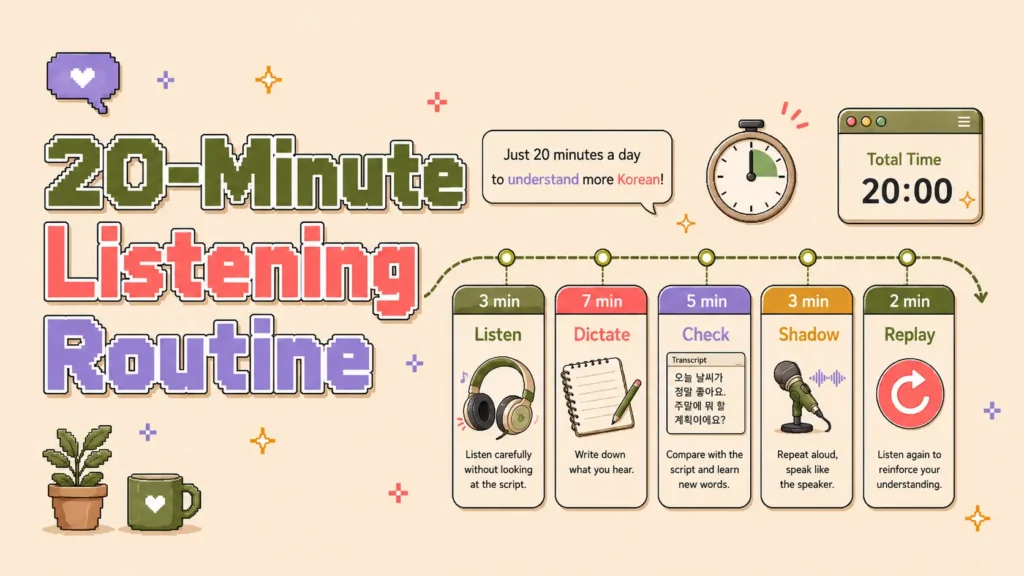
You do not need a complicated four-week program to start.
Take one short piece of audio and use this routine:
| Time | What to do |
|---|---|
| 3 min | Listen normally without looking at the transcript |
| 7 min | Replay short sections and write what you hear |
| 5 min | Check the transcript and mark your listening gaps |
| 3 min | Shadow the difficult sentences |
| 2 min | Listen to the full clip again |
That is enough for a focused session.
On busy days, make it ten minutes. On another day, skip dictation and spend 30 minutes listening extensively instead.
Consistency matters more than turning every session into a major project.
How to Know Your Korean Listening Is Improving
Listening progress can feel invisible.
You may still fail to understand entire conversations and assume nothing has changed. In reality, the early signs are usually much smaller.
Look for these changes:
- You catch more words during the first listen.
- You leave fewer blanks during dictation.
- Words you already studied become easier to recognize.
- You understand common sentence endings without translating them.
- Korean subtitles confirm what you heard instead of revealing something completely unexpected.
- You can follow longer sections before losing the thread.
- Fast Korean starts sounding less blurry.
- You can summarize the main point even when you missed individual words.
The first sign of improvement is usually not understanding everything.
It is realizing that more of the audio sounds familiar.
A simple way to measure this is to keep one short listening sample every few weeks.
Listen once and write a quick summary. Do a short dictation section. Record what you missed.
Then repeat the same type of exercise later.
You will have something more useful than “I think my listening is getting better.”
What This Looks Like in a Real Listening Practice
I tried this with a short Korean listening video that plays the conversation once without subtitles, then again with Korean subtitles.
On the first listen, I could follow most of the conversation, but a few parts were much less clear than I expected.
One was this sentence:
그래서 오늘은 맛있는 거 먹으면서 스트레스 풀자!
So today, let’s eat something delicious and relieve some stress!
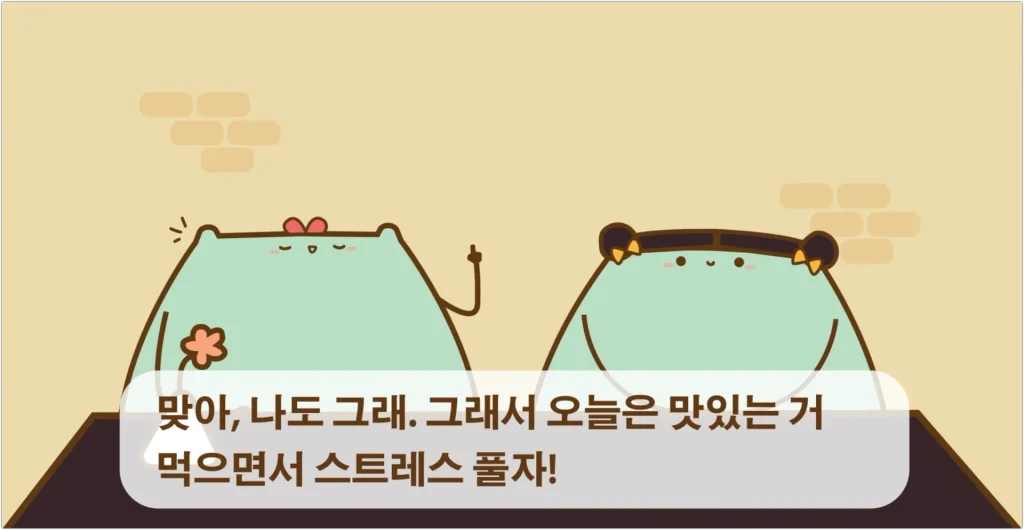
I almost missed 스트레스.
That was interesting because 스트레스 was not a new word. I already knew what it meant. The problem was recognizing it quickly enough when it appeared in the middle of a full sentence.
So instead of adding 스트레스 to a vocabulary list, I went back and listened to the larger chunk:
먹으면서 스트레스 풀자
Then I repeated it with the speaker and listened to the original sentence again.
Another difficult line was:
가끔! 기분 좋을 때만. 부르면 잘 안 와.
Sometimes! Only when she’s in a good mood. She rarely comes when I call her.
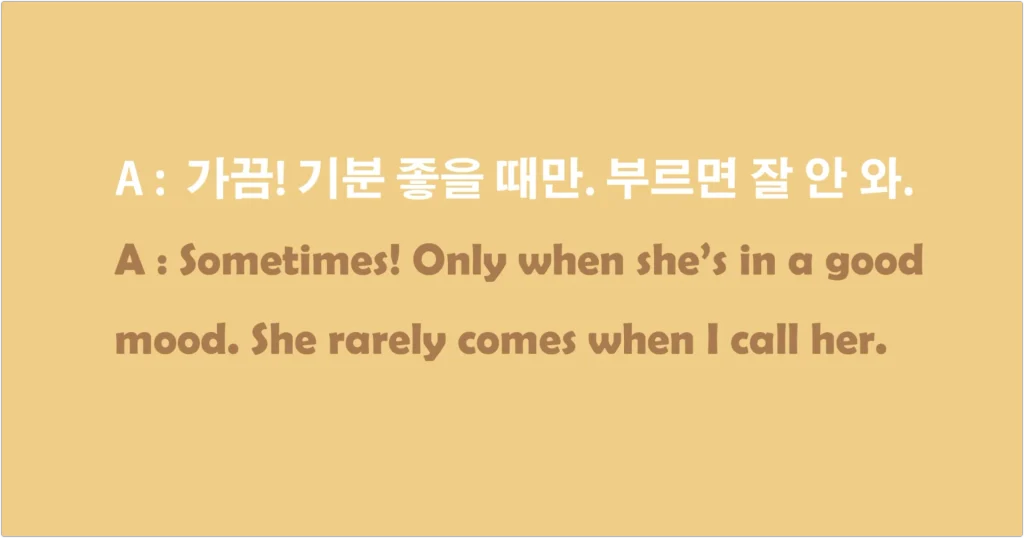
I knew 부르면, 잘, 안, and 와 separately. But in natural speech, 부르면 잘 안 와 was pronounced as one smooth chunk rather than four clearly separated words. There is no major sound change in 안 와 itself, but the lack of pauses made the word boundaries harder to catch on the first listen.
This gave me two different listening problems from just one short practice session:
| What I missed | What the problem actually was |
|---|---|
| 스트레스 | I knew the word but did not recognize it fast enough |
| 부르면 잘 안 와 | I knew the words but struggled to separate them in connected speech |
That is why I find short listening practice more useful than simply asking, “How much Korean did I understand?”
When something disappears on the first listen, I can check the Korean transcript and ask a much more useful question:
Was this a word I did not know, or a word I knew but could not hear?
If it is new vocabulary, I learn it. If I already know it, I replay the whole phrase, shadow the speaker, and listen again without subtitles.
The second type is especially valuable. It shows me exactly which familiar Korean words my ears have not learned to recognize automatically yet.
Put These Korean Listening Methods Into Practice with KoreanClass101
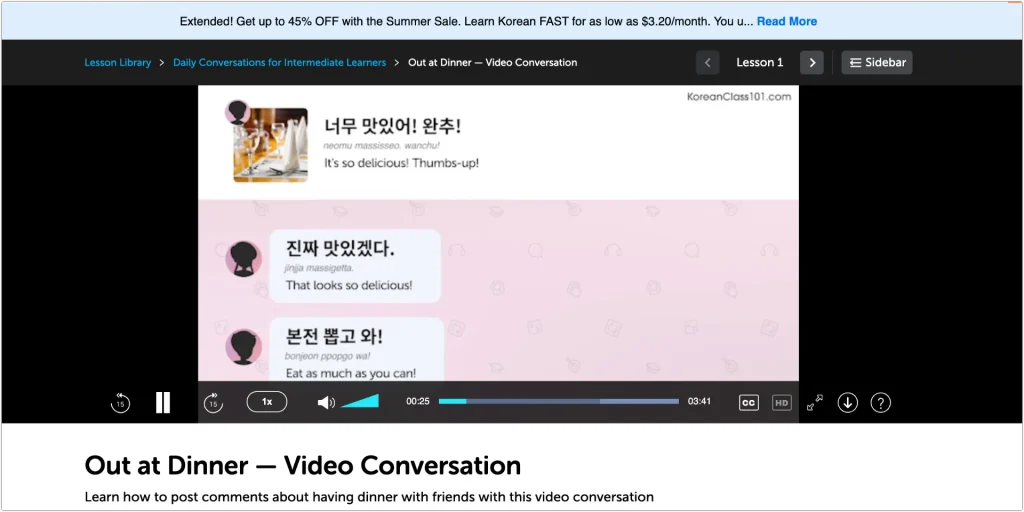
After learning the methods in this guide, KoreanClass101 gives you a convenient place to start practicing them right away.
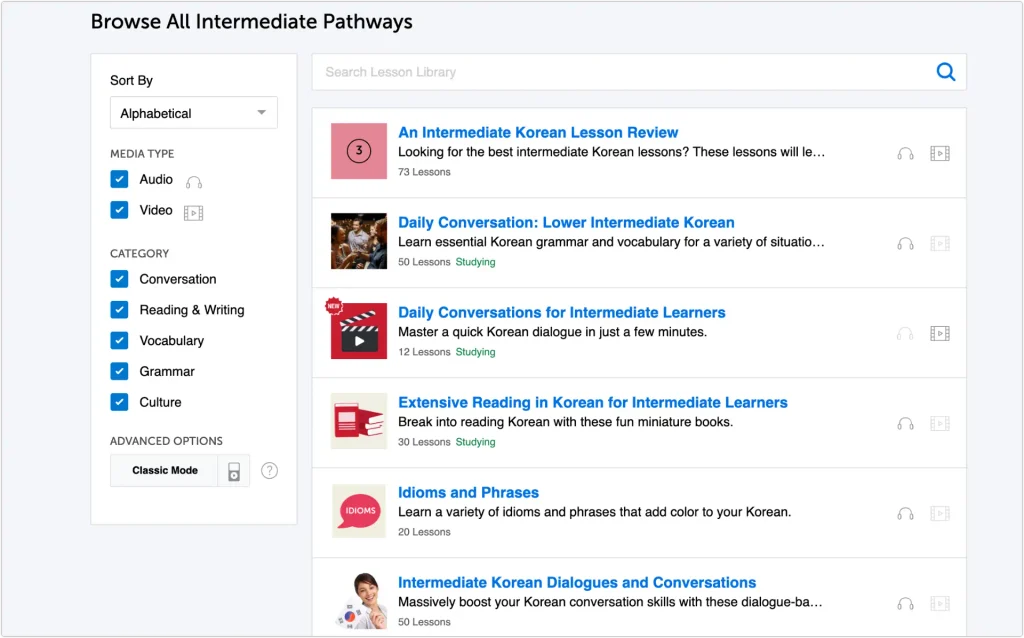
The intermediate lesson library includes audio and video lessons, daily conversations, dialogue-based courses, vocabulary, grammar, and reading material. You can choose a lesson close to your level instead of spending more time searching for practice material.
Practice with Short Korean Dialogues
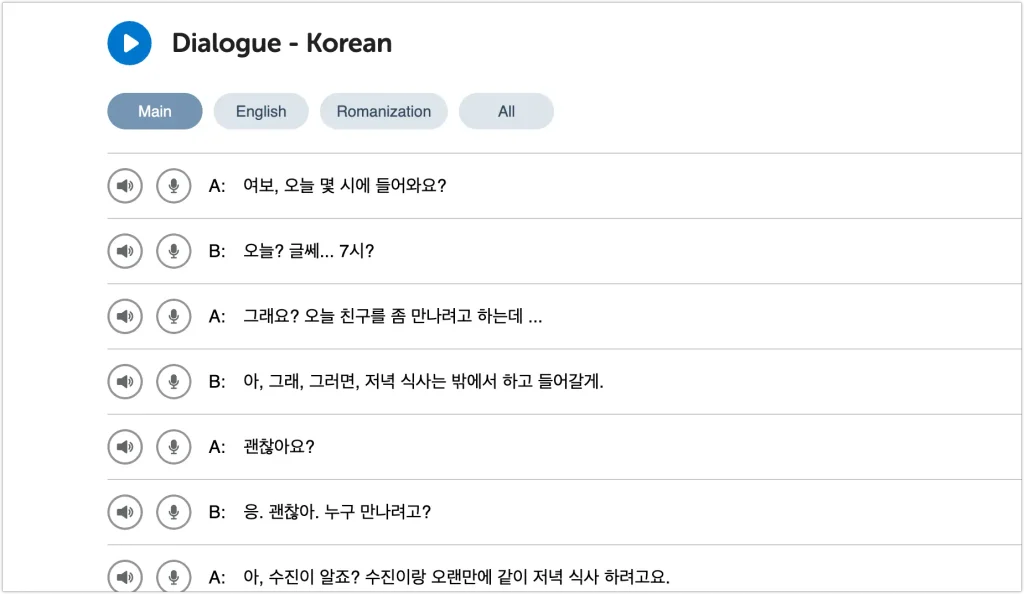
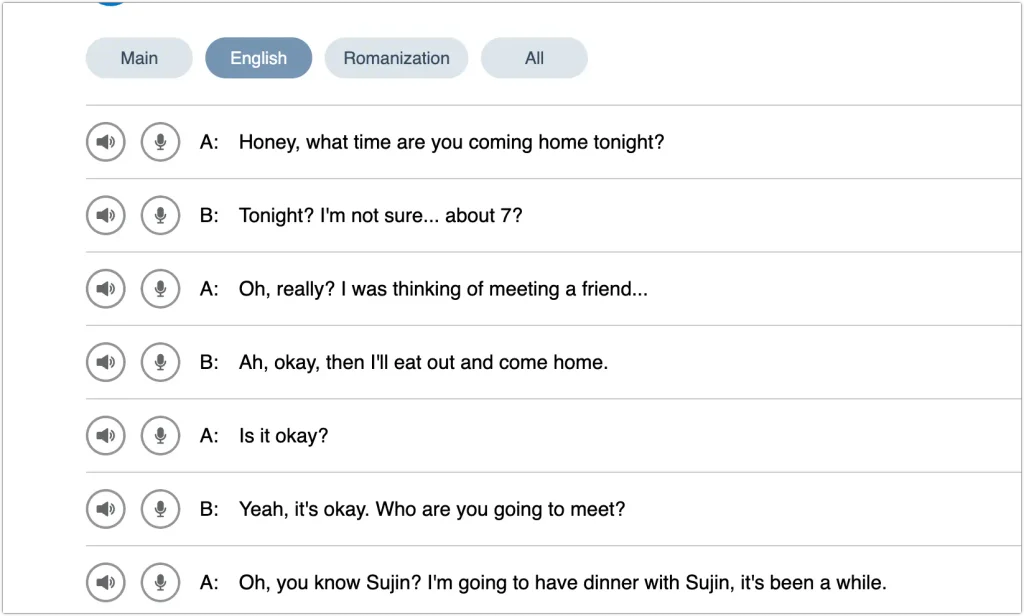
Many lessons are built around short Korean conversations.
You can listen to the full dialogue first, replay individual lines, and then check the transcript after you have tried to catch the Korean yourself.
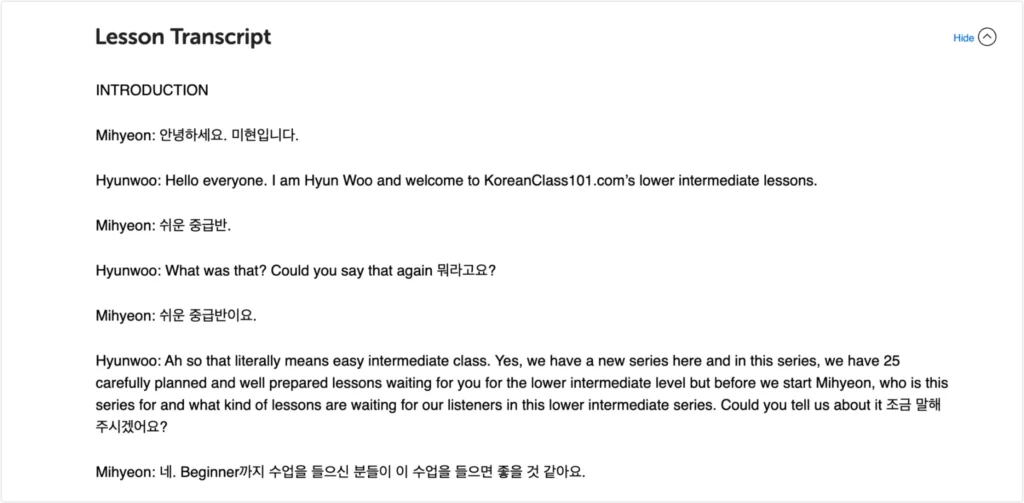
This works especially well for the dictation and transcript-checking method earlier in this guide.
Check Exactly What You Missed
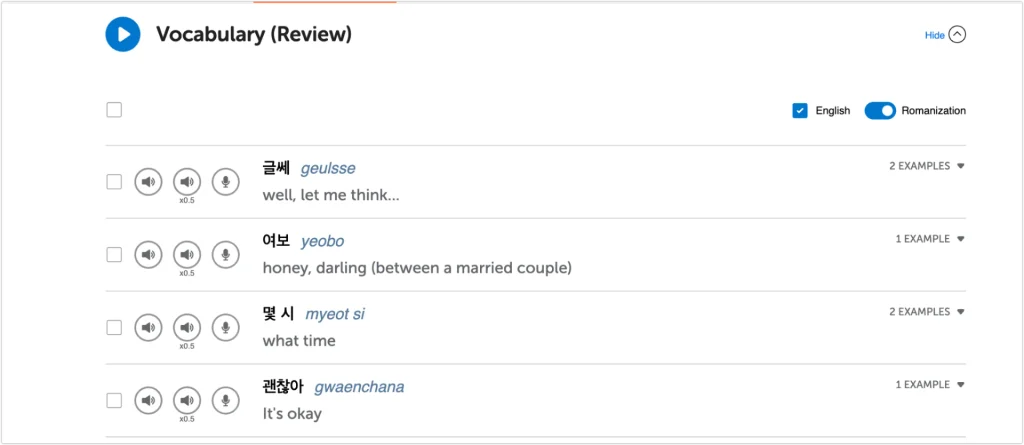
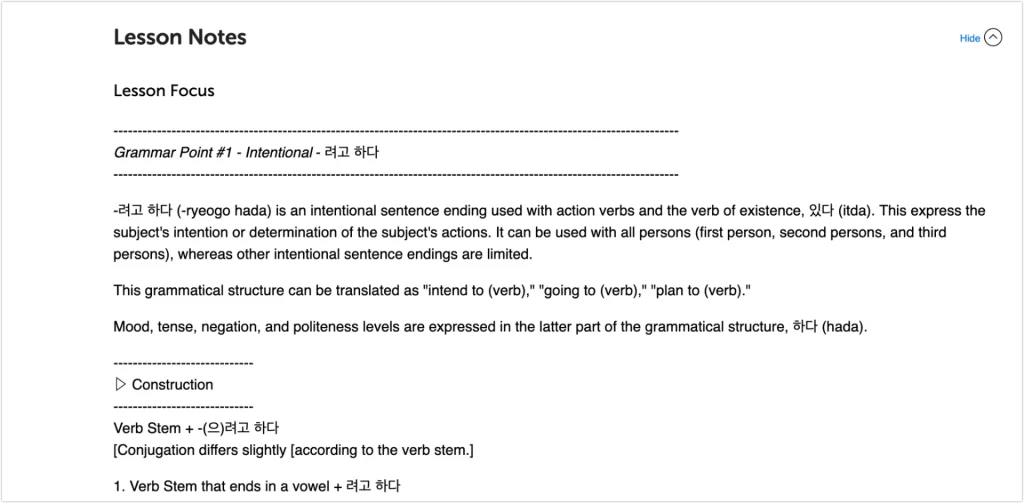
The lessons also include vocabulary review, grammar notes, English support, and line-by-line audio.
That makes it easier to figure out why a sentence was difficult.
You can quickly check whether you missed a new word, a familiar word in connected speech, or a grammar pattern you understood only after seeing it written down.
Move from Learner Korean to Native Content
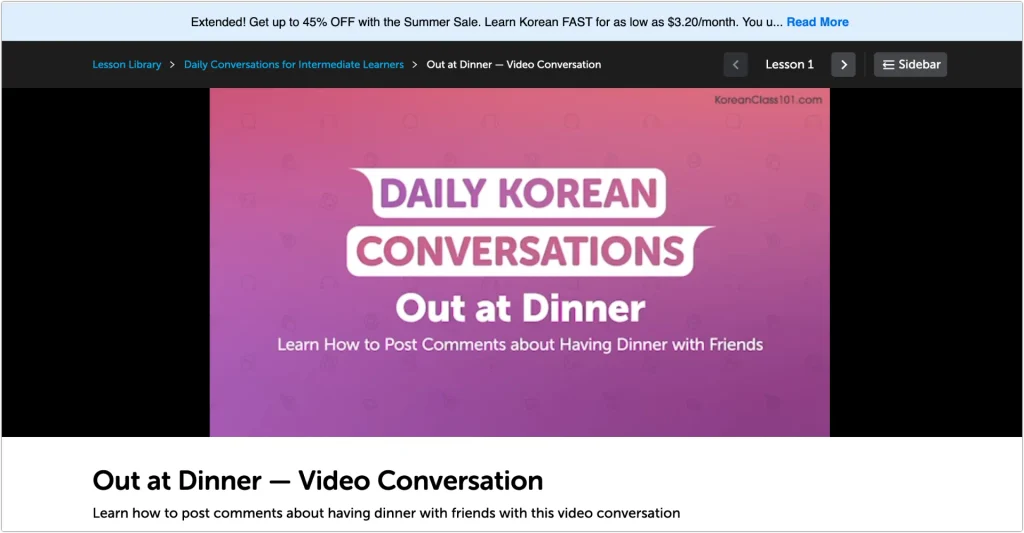
The goal is not to stay with learner material forever.
Use KoreanClass101 to make difficult sounds, phrases, and sentence patterns more familiar. Then return to K-dramas, podcasts, YouTube videos, or variety shows and see whether you can catch more on the first listen.
How to Improve Korean Listening FAQs
Why can I read Korean but not understand spoken Korean?
Reading gives you time to recognize spelling, grammar, and vocabulary. Spoken Korean requires you to recognize the same information immediately while sounds are connecting and the speaker is continuing.
The solution is not simply reading harder material. Practice linking familiar written Korean to its natural spoken form through transcripts, dictation, and repeated listening.
Why does Korean sound so fast even when I know the vocabulary?
Korean can feel fast because the words you know on paper do not always arrive as clearly separated sounds in real speech.
Liaison, 받침 changes, reduced endings, and connected pronunciation can make several familiar words sound like one continuous chunk. You may know every word individually but still need more practice recognizing the spoken version automatically.
Short dictation exercises and transcript checking are especially useful here because they show you exactly where a familiar written form stopped matching what your ear expected to hear.
What is the best Korean listening material for beginners?
Start with material where you can follow the main idea without translating every sentence.
Learner podcasts, slow Korean videos, short dialogues with transcripts, and beginner-friendly vlogs are usually easier to work with than fast dramas or variety shows.
Structured learner content such as TTMIK listening material can also be useful because you can hear Korean at a more manageable level and check what you heard afterward.
As comprehension improves, gradually add more natural native content rather than jumping straight from textbook dialogues to the hardest shows you can find.
Does watching K-dramas improve Korean listening?
Yes, especially when the language is near your level and you rewatch short sections actively.
For focused practice, try watching a scene with Korean subtitles, replaying it without subtitles, and then turning the subtitles back on to check what you missed.
Watching only with English subtitles still gives you Korean exposure, but it gives your brain much less reason to decode the Korean audio itself.
Should I use Korean subtitles when practicing listening?
Yes. Korean subtitles can be a useful bridge between reading and listening.
Try not to stare at them through every listening exercise. Use them to understand or check a scene, turn them off to test yourself, then return to the text when you need to diagnose a missed line.
The goal is not to prove that you can survive without subtitles. It is to gradually need them less.
How can I practice for the TOPIK listening section?
The same active listening routine works well with TOPIK practice audio.
First, complete the question under normal test conditions without pausing. Then return to difficult sections and write down what you hear. Compare your version with the transcript, mark unknown vocabulary and pronunciation problems, and replay the section again.
Keep this detailed review separate from your actual mock-test practice. You still need full listening sessions where you cannot pause, rewind, or check a transcript.