Key Takeaways
- If you understand English when you read it but miss the same language in speech, listening more is not always enough.
- Intensive listening uses a very small piece of audio to find exactly where your comprehension breaks.
- A practical cycle is: listen → write → compare → analyze → relisten → reconstruct.
- Dictation works best when you investigate why you misheard something instead of simply copying the correct transcript.
- Use intensive listening for difficult material and extensive listening for volume. You need both.
If you are trying to figure out how to improve English listening skills after years of studying, “listen to more English” can start to feel like useless advice.
You may already watch videos, listen to podcasts, and understand plenty of English on the page. Yet the moment someone speaks naturally, familiar words disappear. Add linking, reductions, unfamiliar phrasing, or a long sentence, and something you would understand instantly in writing becomes much harder to process.
This is where I would stop increasing the amount of audio and start looking more closely at what I am failing to hear.
The method I use for that is intensive listening.
Instead of listening to another 40-minute podcast and hoping comprehension improves, I take 20–30 seconds of difficult audio and work through it until I understand not only what was said, but why I missed it the first time.
Why Your English Listening Can Stop Improving
At beginner level, more comprehensible input often produces visible progress. You learn more vocabulary, get used to common sentence patterns, and begin recognizing language you have heard repeatedly.
Later, the problem becomes less obvious.
You may look at a transcript and think:
I know every word in this sentence. Why didn’t I hear any of it?
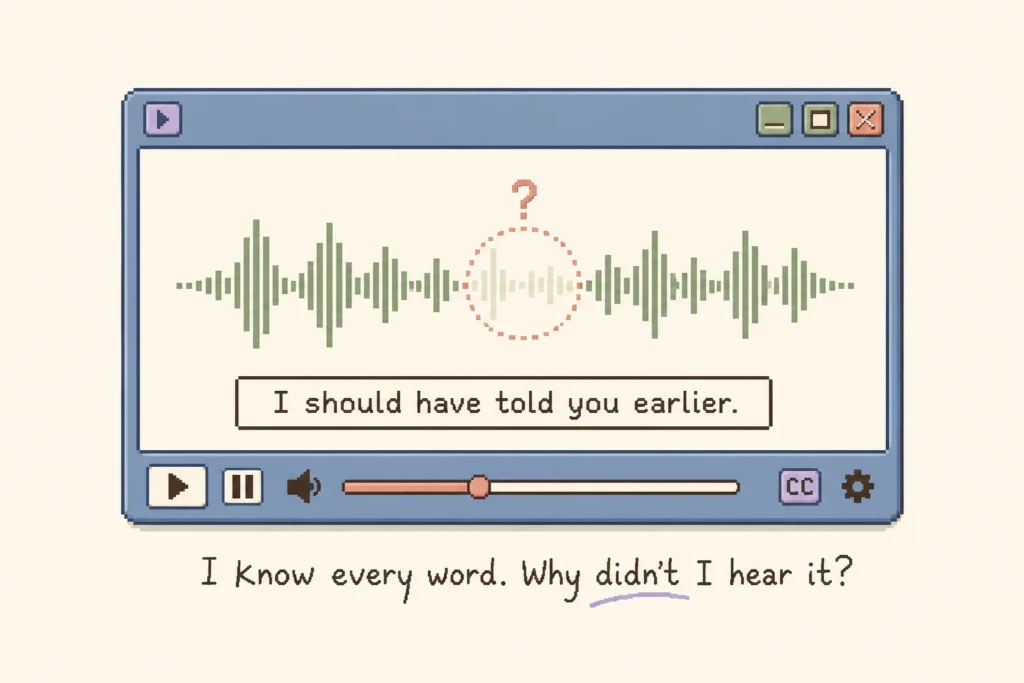
That gap can come from several places.
Maybe you know the written form of a word but have not built a strong connection to its spoken form. Maybe two words sounded like one. Maybe you heard every individual sound but could not process the sentence quickly enough before the speaker moved on.
Sometimes the problem is not listening alone. You missed a reference, grammar structure, idiom, or piece of context, so even a perfectly clear recording would still be difficult to understand.
This is why simply replaying the same sentence ten times is not always enough.
You need to find out what kind of listening failure happened.
What Is Intensive Listening?
Intensive listening means working closely with a short piece of audio rather than trying to understand a large amount of material.
The goal is not to finish the episode.
It is to investigate the gap between:
what was actually said
and
what your ears were able to process.
That may involve listening several times, writing down what you hear, checking a transcript, looking up vocabulary, analyzing a difficult sentence, and listening again after you understand it.
For stronger learners, I particularly like material that is slightly above the level of comfortable everyday listening. Long-form interviews, lectures, debates, or serious podcasts can expose you to denser sentence structures and vocabulary than learner material.
But you are not going to intensively study the whole recording at once.
You are going to take 20 seconds.
Who Should Use This Method?
This method becomes especially useful once you can already understand a fair amount of written English.
Around B1–B2
Choose relatively clear audio with a reliable transcript.
Interviews, documentaries, learner-friendly podcasts, and clear YouTube videos are good starting points. The main goal is to close the gap between vocabulary you recognize in writing and vocabulary you can recognize by ear.
Around B2–C1
This is where intensive listening becomes particularly useful.
You may already understand the overall message of native content, but long sentences, fast transitions, reduced speech, unfamiliar registers, and abstract vocabulary still create gaps.
Instead of looking for another intermediate listening course, you can start using real material and investigate those gaps directly.
Complete Beginners
I would not start with difficult native audio yet.
If almost every sentence contains unknown vocabulary and grammar, the activity turns into intensive decoding rather than intensive listening.
Use easier input first. Come back to this method once you can already understand the general meaning of the material.
My Intensive Listening Method
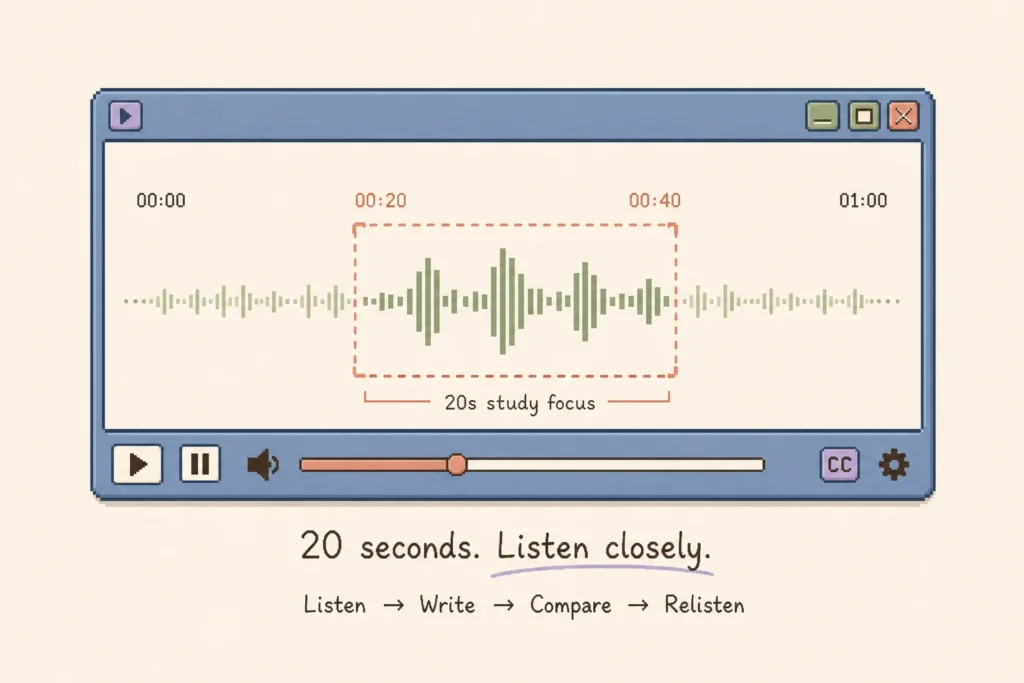
Step 1. Choose 20–30 Seconds of Difficult Audio
The biggest mistake is choosing too much material.
If you start with five minutes of difficult speech, the amount of unknown language quickly becomes overwhelming. Twenty to thirty seconds is enough to contain several useful problems without turning one study session into a transcription project.
Choose audio that is difficult but not completely meaningless.
Ideally, you should be able to identify the general topic even if the details are hard to follow.
For intermediate learners, a clear podcast or interview works well. At a stronger B2–C1 level, you can move into faster interviews, lectures, news analysis, debates, or other native material.
Step 2. Listen Without the Transcript
Play the section once.
Do not read subtitles. Do not pause after every word. Do not immediately ask AI what the sentence means.
Your first listen is a diagnostic.
Ask yourself:
- What is the speaker talking about?
- Which words did I definitely hear?
- Where did the sentence become unclear?
- Did I lose the vocabulary, the grammar, or the sound?
You are establishing what your ears can currently process without help.
Step 3. Write Down Exactly What You Hear
Now replay the section and write down as much as you can.
This is where English dictation practice becomes useful.
The goal is not to produce a beautiful transcript. Write what you actually think you heard, including uncertain words and blank spaces.
For example:
The government has ______ a new approach to…
or even:
the government has… something… new approach…
That messy version is valuable.
It shows you where comprehension broke.
If you open the transcript first, you lose that information.
Step 4. Compare Your Version With the Transcript
Now check the official transcript or accurate subtitles.
Do not immediately erase your mistakes.
Compare the two versions and ask what kind of problem caused the difference.
1. I didn’t know the word.
That is mainly a vocabulary problem.
2. I knew the word but didn’t recognize the sound.
This is a much more interesting listening problem.
You may know exactly what the word means when you see it, but its real spoken form is not yet familiar enough to recognize automatically.
3. I split the words incorrectly.
You may have heard two or three words as one sound, or placed the word boundary in the wrong place.
Connected speech, reductions, and weak forms often cause this.
4. I heard the words but misunderstood the sentence.
This suggests that the problem may be processing speed, syntax, collocation, or context rather than sound recognition.
5. I missed a grammar structure or reference.
Sometimes you technically heard the sentence correctly but still did not understand who or what a pronoun referred to, how a clause was connected, or why a particular tense or structure was used.
These five categories matter because different listening problems need different solutions.
Learning more vocabulary will not fix a word you already know but cannot recognize by ear.
Step 5. Investigate Why You Missed the Sentence
This is the part I would spend the most time on.
Do not reduce the process to:
English sentence → translation → done.
Look at the sentence itself.
If a pronoun appears, ask what it refers to.
If you recognize every word but the meaning still feels strange, examine the grammar.
If two familiar words sounded completely different in the recording, replay the exact transition between them.
If an expression looks unusual, check whether it is a fixed phrase or collocation.
Questions such as these are much more useful:
What does it refer to in this sentence?
Why is the present perfect used here?
Which words are connected when the speaker says this?
Is this expression common, formal, or specific to this context?
What is the grammatical structure of this clause?
AI is useful at this stage because you can ask about one very specific problem rather than requesting a translation of the whole paragraph.
I would still verify explanations that matter, especially grammar and usage. My 6-step method for checking English with ChatGPT uses the same principle: AI can help identify a problem, but it should not automatically become the final authority.
Step 6. Listen Again After You Understand the Sentence
Now return to the audio.
This listen often feels completely different.
A stretch of speech that sounded like noise suddenly separates into words. A word you thought had disappeared becomes obvious. A long sentence becomes easier because you now know how its parts fit together.
This is one of the most useful moments in intensive listening.
You are connecting the English you can understand intellectually with the sound pattern you need to recognize automatically.
Do not rush past it.
Replay the sentence several times until following the meaning feels easier.
Step 7. Reconstruct the Sentence From Memory
Traditional dictation often stops once you have corrected your transcript.
I like adding one more step.
Close the transcript and try to reconstruct the sentence again.
You can write it, say it aloud, or retell the same idea in your own English.
This is harder than copying the correct version because you have to retrieve the vocabulary and structure yourself.
You may discover that you can now understand the sentence perfectly but still cannot reproduce an important expression.
That is useful information too.
Recognition and production are different levels of knowing a language.
Step 8. Listen One Final Time Without Reading
Finish the section the same way you started it: audio only.
This time, do not translate sentence by sentence.
Follow the meaning.
If the section now feels much easier, move to the next 20–30 seconds.
If one part still disappears, that is the part worth replaying—not the entire recording.
Over time, you should need less analysis for the same level of material.
That is the progress you are looking for.
A Simple Intensive Listening Workflow
You can reduce the entire method to this:
| Stage | What to Do | What You Are Checking |
|---|---|---|
| 1. Blind listen | Listen without text | What can I already process? |
| 2. Dictation | Write what you hear | Where does comprehension break? |
| 3. Transcript check | Compare with the original | What exactly did I miss? |
| 4. Analysis | Check words, grammar, references and sound | Why did I miss it? |
| 5. Relisten | Listen after understanding | Can I now recognize it by ear? |
| 6. Reconstruct | Say or write it from memory | Can I retrieve the language? |
| 7. Final listen | Listen without support | Can I follow the meaning naturally? |
The important part is not completing every step perfectly.
It is identifying the weak link.
Intensive Listening vs. Extensive Listening
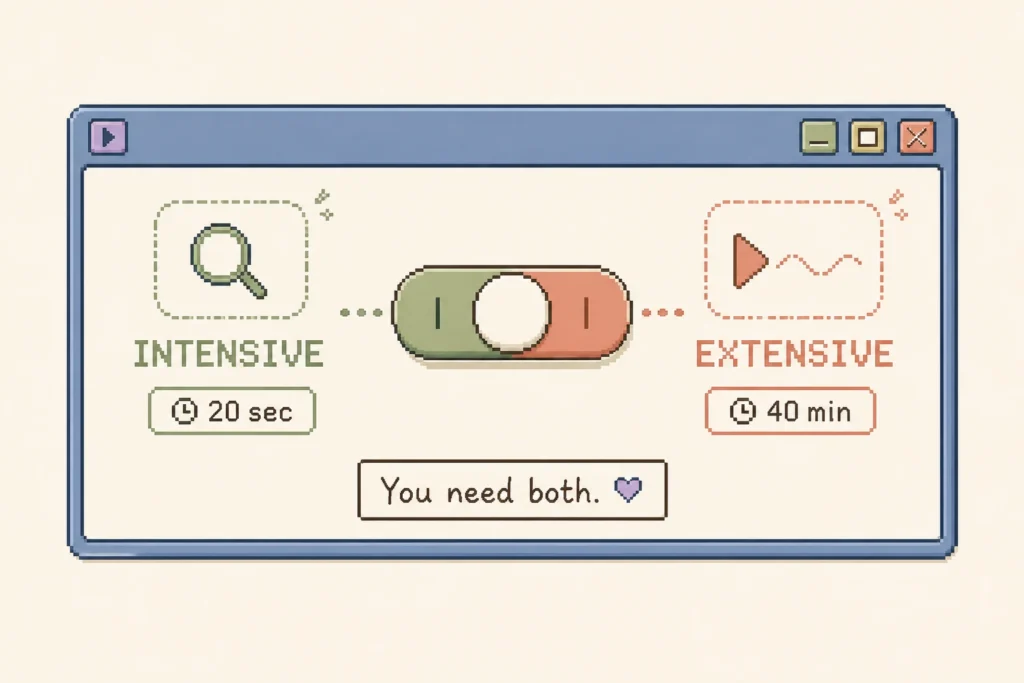
I would not replace all normal listening with this method.
Intensive listening and extensive listening solve different problems.
Extensive listening means spending much more time listening for general meaning. You may walk while listening to a podcast, watch a long interview, or follow a show without stopping every time you miss something.
That builds volume and familiarity.
Intensive listening slows everything down and asks:
Where exactly did my comprehension fail?
| Intensive Listening | Extensive Listening | |
|---|---|---|
| Amount | Very short sections | Longer content |
| Goal | Accuracy and diagnosis | Fluency and exposure |
| Transcript | Often useful | Usually optional |
| Pausing | Frequent | Minimal |
| Unknown words | Investigate selectively | Usually keep going |
| Best for | Fixing specific listening gaps | Building listening volume |
You need both.
If you only do extensive listening, you can keep making the same mistakes without noticing them.
If you only do intensive listening, language learning can become painfully slow and you lose the experience of simply following ideas in English.
My preference is simple:
most listening = extensive
a small amount = intensive
Use intensive listening on the material that exposes a real weakness.
How Much Audio Should You Study?
Very little.
That is one of the hardest things to accept about this method.
A 20-minute recording can produce an enormous amount of work if the language is difficult enough. You might spend an entire session on one minute of audio.
That does not mean the method is inefficient.
The goal is not to finish the recording. The goal is to train the points that normal listening keeps allowing you to skip.
I would rather understand one difficult minute deeply than spend an hour listening while repeatedly losing the thread.
At the same time, there is no prize for analyzing every word.
If one sentence contains an obscure reference you will probably never meet again, understand enough to continue and move on.
Do not turn intensive listening into perfectionism.
What Kind of Audio Works Best?
The best material has three qualities:
- You care about the topic.
- It is slightly difficult.
- You can access a reliable transcript or subtitles.
That last point is particularly important for dictation.
Without a reliable reference, you may spend ten minutes trying to hear a word only to discover that the auto-generated subtitle was wrong.
For stronger learners, I particularly like long-form material because it gives you repeated exposure to the same speaker, subject, and vocabulary.
You do not need to analyze the whole thing.
A single interview can provide weeks of short intensive-listening sections.
The Mistake I Would Avoid: Copying the Transcript Too Early
Copying can be useful, but the order matters.
If you look at the transcript and copy it before testing your listening, the page tells you everything your ears were supposed to discover.
I prefer:
hear → attempt → compare → understand → reconstruct
rather than:
read → copy → listen
The first version preserves the diagnostic value of dictation.
If you enjoy handwriting, you can absolutely rewrite important sentences afterward. Just make sure the writing is helping you retrieve and notice the language rather than becoming mechanical copying.
Should You Look Up Every Unknown Word?
No.
An advanced audio clip can contain dozens of unfamiliar words. Turning all of them into flashcards is an easy way to create a review system you eventually stop using.
I would prioritize words and expressions that:
- block your understanding of the sentence;
- appear repeatedly;
- belong to a topic you care about;
- express something you would like to say yourself.
The rest can remain unknown.
Listening comprehension does not require perfect vocabulary coverage.
Does Dictation Really Help With Listening?
Dictation is useful when it gives you information about your listening.
The corrected transcript itself is not the important part.
The valuable question is:
Why is my version different from what the speaker actually said?
Maybe you wrote the wrong tense.
Maybe you heard one word instead of two.
Maybe a familiar word sounded unfamiliar inside connected speech.
Maybe the real problem was an unknown expression.
Once dictation reveals the cause, you know what to work on.
That is much more useful than calculating how many words you got correct.
What Progress Should Feel Like
Do not expect advanced listening progress to look like beginner progress.
At the beginning, progress can be dramatic. You learn 100 new words and suddenly understand things you could not understand last month.
Later, progress becomes more specific.
You start catching phrases the first time.
You stop needing subtitles for a familiar speaker.
Long sentences no longer disappear before you reach the verb.
You can stay inside the meaning of a conversation without mentally translating every line.
And the 30 seconds that once required twenty minutes of analysis begins to require ten.
That is listening progress too.
How to Improve English Listening Skills FAQs
How can I improve my English listening skills?
Combine regular extensive listening with shorter intensive-listening sessions. For intensive practice, work with 20–30 seconds of audio, write what you hear, compare it with a transcript, analyze what you missed, and listen again until the sentence becomes easier to process.
How can I improve my listening comprehension?
Do not focus only on understanding the final meaning. Identify why comprehension failed. The problem may be vocabulary, grammar, connected speech, word boundaries, processing speed, or missing context.
What is intensive listening?
Intensive listening is close study of a short piece of audio. Instead of listening mainly for general meaning, you pause, replay, use a transcript, investigate difficult language, and work out exactly what prevented you from understanding the recording.
Is intensive listening the same as dictation?
No. Dictation can be one step inside intensive listening. Intensive listening can also include transcript comparison, vocabulary and grammar analysis, pronunciation work, repeated listening, and reconstructing the sentence afterward.
Should I use subtitles or transcripts for English listening practice?
Yes, but usually after the first listen.
Listening before reading shows you what your ears can process independently. The transcript then helps you identify what you missed.
How long should intensive listening practice be?
A focused session can be built around only a few minutes of source audio. The harder the material, the less audio you need.
Twenty or thirty seconds can be enough for one useful cycle.
Final Thoughts
If your English listening has stopped improving, the answer may not be another hundred hours of passive exposure.
Sometimes you need to zoom in.
Take a tiny section of real English and find the exact moment comprehension breaks. Write what you hear. Compare it with the transcript. Investigate the problem. Listen again. Then try to reconstruct what you learned without looking.
The process is slow by design.
But after enough repetitions, something changes: language that once existed only on the page begins to arrive through sound without needing to be decoded first.
For me, that is the real goal of advanced listening practice:
listen → notice the gap → understand it → hear it differently next time.